Event submissions
Published
This submission belongs to the session D. Food Microbiology & Biotechnologies of the event The 7th International Electronic Conference on Foods
Published date
23 Oct, 2026
Academic Editor
 Efstathios Giaouris
Citation
Tarik Sebbah, Djahira Hamed, Ahmed Nacef, Karima Bentaiba, Edite Cunha, Identification by MALDI-TOF MS and probiotic characterization of Enterococcus faecium strains isolated from equine milk, in Proceedings of The 7th International Electronic Conference on Foods, 28 October–30 October 2026, MDPI: Basel, Switzerland
Share
Email
Facebook
Twitter
LinkedIn
Identification by MALDI-TOF MS and probiotic characterization of Enterococcus faecium strains isolated from equine milk

Tarik Sebbah 1,2,3
Djahira Hamed 4
Ahmed Nacef 5
Karima Bentaiba 1
Edite Cunha 2
1. Pathological Experimental Research Laboratory (PERL), Faculty of Medicine, Hassiba Benbouali University of Chlef, Hay Essalem 02000, Chlef, Algeria
2. LAQV/REQUIMTE, Department of Chemical Sciences, Faculty of Pharmacy, University of Porto, R. Jorge de Viterbo Ferreira 228, 4050-313 Porto, Portugal
3. Laboratory of Clinical and Metabolic Nutrition, Faculty of Nature and Life Sciences, University of Oran 1 Ahmed Ben Bella, Oran, BP 1524 El M’Naouer - 31000, Algeria
4. Laboratory of Applied Hydrology and Environment, Agri-Food Department, Faculty of Science and Technology, University of Ain Temouchent - Belhadj Bouchaib, PO BOX 284. 46000, Ain Temouchent, Algeria.
5. Department of Physics Sciences, Higher Normal School of Saida, Saida, BP 42 - 20000, Algeria.
Abstract
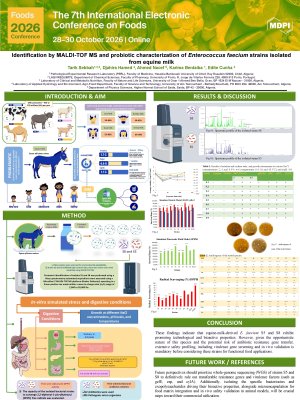
Developing innovative functional foods requires selecting robust, biologically active probiotic microorganisms capable of tolerating processing conditions and gastrointestinal transit. Non-bovine milk serves as a unique repository of underexplored lactic acid bacteria (LAB) with promising health-promoting properties.
This study aimed to isolate, identify, and evaluate LAB strains from raw Algerian equine milk for their technological, safety, and probiotic characteristics.
Nine isolates were screened for environmental adaptability under technological stresses (2–6.5% NaCl, 10–63.5°C, pH 9.8) and subjected to a rigorous in vitro simulated gastrointestinal transit model, including sequential exposure to salivary α-amylase, gastric fluid (pH 2), intestinal fluid (0.05 g/L bile salts, 0.1 g/L lysozyme), and pancreatic enzymes. DPPH radical scavenging capacity, and antagonistic action against five foodborne pathogens, using agar well diffusion method, were also quantified. High-throughput proteomic profiling via MALDI-TOF MS ensured accurate taxonomic classification.
Nine isolates showed strong physiological tolerance, growing in up to 6.5% NaCl and surviving alkaline conditions (pH 9.8). Strains S5 and S8 exhibited high survival rates (>70%) under simulated gastric conditions (pH 2.0, 120 min), exceeding the survival of the reference probiotic strain Bb12. Both strains maintained viability under simulated intestinal conditions containing lysozyme (0.1 g/L) and bile salts (0.05%). MALDI-TOF MS identified S5 and S8 as Enterococcus faecium with high-confidence identification scores of 2.40 and 2.36, respectively. Strain S8 showed antimicrobial activity against Staphylococcus aureus (15.33 mm) and Bacillus cereus (16.33 mm) and demonstrated antioxidant activity of 67.74 ± 1.0%, comparable to the reference strain Bb12 (63.84%).
These findings indicate that equine-milk-derived E. faecium S5 and S8 exhibit promising technological and bioactive properties. However, given the opportunistic nature of this species and the potential risk of antibiotic resistance gene transfer, extensive safety profiling, including virulence gene screening and in vivo validation is mandatory before considering these strains for functional food applications.
Keywords
Non-bovine milk
In vitro digestion model
Gastrointestinal resilience
Proteomic bio-typing
Enterococcus faecium
Antioxidant and antimicrobial activity
Probiotic potential.
Poster
FOODS27_Equine Milk.pdf
Cronobacter turicensis within the Cronobacter genus (Enterobacteriaceae): genomic architecture and evolutionary stability
Development of lactic acid bacteria starters for cheesemaking isolated from different dairy matrices in Gran Canaria (Canary Islands)