Event submissions
Published
This submission belongs to the session D. Food Microbiology & Biotechnologies of the event The 7th International Electronic Conference on Foods
Published date
23 Oct, 2026
Academic Editor
 Efstathios Giaouris
Citation
Yésica Pallavicini, Luciana Biondi, Sara Diosdado Ruipérez, Marta Sánchez Martín, María Virginia Ozcariz Fermoselle, Biotechnological development of active polymeric biostructures containing nanoencapsulated essential oils for antifungal protection of horticultural produce, in Proceedings of The 7th International Electronic Conference on Foods, 28 October–30 October 2026, MDPI: Basel, Switzerland
Share
Email
Facebook
Twitter
LinkedIn
Biotechnological development of active polymeric biostructures containing nanoencapsulated essential oils for antifungal protection of horticultural produce

Yésica Pallavicini 1
Luciana Biondi 1
Sara Diosdado Ruipérez 1
Marta Sánchez Martín 1
María Virginia Ozcariz Fermoselle 1
1. R&D Department, Centro Tecnológico Agrario y Agroalimentario - ITAGRA.CT, Palencia, 34004, Spain
Abstract
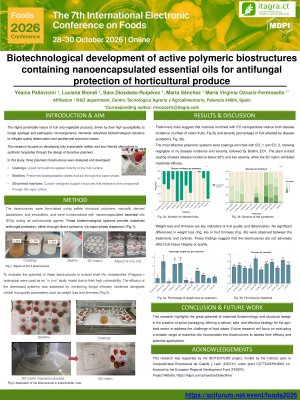
The highly perishable nature of fruit and vegetable products, driven by their high susceptibility to fungal spoilage and pathogenic microorganisms, demands advanced biotechnological solutions to mitigate quality deterioration and postharvest economic losses. This research focuses on developing fully sustainable, edible, and eco-friendly alternatives to synthetic fungicides through the design of bioactive biopolymers.In this study, three innovative polymeric systems were designed and developed: coatings (liquid phase applied directly to the surface), biofilms (preformed biodegradable sheets), and 3D-printed matrices (bio-designed support structures). These biostructures were formulated using edible structural polymers, naturally derived plasticizers, and emulsifiers, and were functionalized with nanoencapsulated essential oils (EOs) acting as antimicrobial agents. These biotechnological systems provide sustained antifungal protection, either through direct contact or via vapor-phase dispersion.To evaluate and validate the potential of these biostructures to extend shelf life, strawberries (Fragaria × ananassa) were used as an “in vivo” study model due to their high vulnerability. The efficacy of the developed systems was assessed by monitoring fungal infection incidence alongside critical fruit quality parameters, such as color, weight loss, and firmness.Preliminary trials suggest that applying these matrices—enriched with EO nanoparticles—reduces both the number of infected fruits and the severity of symptoms. Furthermore, the use of these biostructures ensures the preservation of key physicochemical attributes during storage. This research highlights the great potential of materials biotechnology and structural design in the creation of active packaging, offering a natural, safe, and effective strategy for the agri-food sector to address the challenge of food waste.
Keywords
biofilm
3D-printed matrices
coatings
biostructures
edible film
Poster
AA_Poster_FOODS.pdf
Development of lactic acid bacteria starters for cheesemaking isolated from different dairy matrices in Gran Canaria (Canary Islands)
A RAPID AND NON-DESTRUCTIVE COSY NMR APPROACH FOR DISTINGUISHING BUTYRIC AND n-3 FATTY ACID MOIETIES IN DAIRY FAT MATRICES