Event submissions
Published
This submission belongs to the session C. Food Physicochemistry & Analysis of the event The 7th International Electronic Conference on Foods
Published date
23 Oct, 2026
Academic Editor
 Joana S. Amaral
Citation
Alin Barna, Cristina-Elena Stavarache, Nicoleta-Aurelia Chira, Mihaela Tociu, Aurelia Bratu, Mihaela-Liliana Mihalache, A RAPID AND NON-DESTRUCTIVE COSY NMR APPROACH FOR DISTINGUISHING BUTYRIC AND n-3 FATTY ACID MOIETIES IN DAIRY FAT MATRICES, in Proceedings of The 7th International Electronic Conference on Foods, 28 October–30 October 2026, MDPI: Basel, Switzerland
Share
Email
Facebook
Twitter
LinkedIn
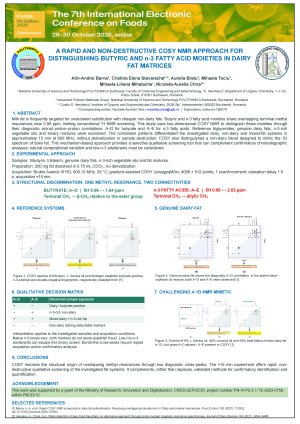
A RAPID AND NON-DESTRUCTIVE COSY NMR APPROACH FOR DISTINGUISHING BUTYRIC AND n-3 FATTY ACID MOIETIES IN DAIRY FAT MATRICES

Alin Barna 1
Cristina-Elena Stavarache 2
Nicoleta-Aurelia Chira 1
Mihaela Tociu 1
Aurelia Bratu 1
Mihaela-Liliana Mihalache 1
1. “C. Nenitescu” Department of Organic Chemistry, Faculty of Chemical Engineering and Biotechnology, National University of Science and Technology POLITEHNICA Bucharest, Bucharest, 060042, Romania
2. Advanced Polymer Materials Group, Faculty of Chemical Engineering and Biotechnology, National University of Science and Technology POLITEHNICA Bucharest, Bucharest, 060042, Romania
Abstract
Background: Milk fat is a high-value food ingredient frequently targeted for adulteration with cheaper
non-dairy fats and oils. Butyric acid is a characteristic marker of dairy fat, whereas n-3 fatty acids are
generally present only at trace levels in milk fat but may occur in substantially higher amounts in
vegetable oils used as adulterants. Conventional analytical approaches, including gas chromatography and
classical volatility indices, are informative but often laborious, destructive, and time-consuming.
Objective: This study aimed to develop a rapid, non-destructive, and mechanism-based NMR screening
strategy capable of differentiating butyric moieties (specific to dairy fat) from n-3 fatty acids
(characteristic of vegetable oils), despite the overlap of their terminal methyl resonances in one-
dimensional 1 H-NMR spectra.
Methods: A two-dimensional COSY (COrrelation SpectroscopY) NMR approach was applied to reference
triglycerides, authentic dairy fats, vegetable oils rich in n-3 fatty acids, and binary fat mixtures. Sample
classification was based on the presence or absence of diagnostic vicinal H-H correlations, namely the
butyrate-specific A–D cross-peak and the n-3-specific A–E cross-peak.
Results: The COSY spectra enabled clear differentiation among dairy fats, n-3-rich non-dairy fats, mixed
dairy/non-dairy systems, and saturated non-dairy fats lacking both markers. The proposed spectral
criterion resolved the ambiguity associated with the overlapped terminal methyl signal observed in
conventional 1 H-NMR and allowed rapid qualitative classification of the analyzed samples in
approximately 15 minutes, without derivatization or sample destruction.
Conclusions: The proposed COSY NMR method provides a rapid, selective, and non-invasive tool for
dairy fat authentication and for the detection of adulteration with vegetable oils in complex lipid matrices.
It is suitable as a first-line screening method and may complement confirmatory chromatographic analyses
in routine quality-control workflows.
Acknowledgement
This work was supported by a grant of the Ministry of Research, Innovation and Digitalization, CNCS-
UEFISCDI, project number PN-IV-P2-2.1-TE-2023-0756, within PNCDI IV.
Keywords
COSY NMR
butyric acid
n-3 fatty acids
dairy fat authentication
food adulteration
non- destructive analysis
Poster
Poster_Sciforum_180070_Barna.pdf
Biotechnological development of active polymeric biostructures containing nanoencapsulated essential oils for antifungal protection of horticultural produce
Evaluation of the microbiological quality of mayonnaise using an accelerated shelf-life test