Event submissions
Published
This submission belongs to the session D. Food Microbiology & Biotechnologies of the event The 7th International Electronic Conference on Foods
Published date
23 Oct, 2026
Academic Editor
 Efstathios Giaouris
Citation
Ingryd Carolly de Oliveira Medeiros, Carlos Augusto de Senna Azevedo, Giovanna Isabelle Camilo, Antenor Correia da Silva Júnior, Mayke Sombra Barbosa, ÁLVARO DANIEL TELES PINHEIRO, Mayra Thayna de Oliveira Silva, Evaluation of the microbiological quality of mayonnaise using an accelerated shelf-life test, in Proceedings of The 7th International Electronic Conference on Foods, 28 October–30 October 2026, MDPI: Basel, Switzerland
Share
Email
Facebook
Twitter
LinkedIn
Evaluation of the microbiological quality of mayonnaise using an accelerated shelf-life test

Ingryd Carolly de Oliveira Medeiros 1
Carlos Augusto de Senna Azevedo 1
Giovanna Isabelle Camilo 2
Antenor Correia da Silva Júnior 2
Mayke Sombra Barbosa 1
ÁLVARO DANIEL TELES PINHEIRO 3
Mayra Thayna de Oliveira Silva 4
1. Department of Natural Sciences, Mathematics, and Statistics (DCME), Federal Rural University of the Semi-Arid Region (UFERSA), Mossoró, RN, Brazil.
2. Department of Biosciences (DBIO), Federal Rural University of the Semi-Arid Region (UFERSA), Mossoró, RN, Brazil.
3. Department of Engineering and Technology, Federal Rural University of the Semi-Arid Region (UFERSA), Mossoró, RN, Brazil.
4. INDUTEL Sweets and Seasonings Industry Ltd., Mossoró, RN, Brazil.
Abstract
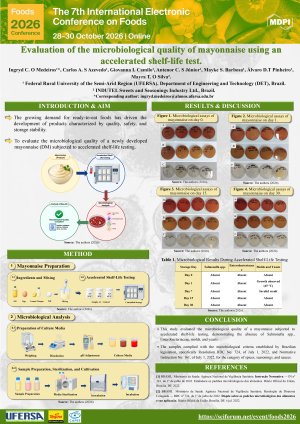
The growing demand for ready-to-eat foods has driven the development of products characterized by quality, safety, and storage stability. This study aimed to evaluate the microbiological quality of a newly developed mayonnaise (DM) subjected to an accelerated shelf-life test. The mayonnaise was produced in accordance with Good Manufacturing Practices and stored under different conditions: a control sample at 25 °C and two samples subjected to thermal stress at 35 °C and 45 °C for 30 days. Microbiological analyses were performed at the established storage intervals, including the detection of Salmonella spp., Enterobacteriaceae, molds, and yeasts, in accordance with current Brazilian legislation, established by Resolution RDC No. 724, of July 1, 2022, and Normative Instruction No. 161, of July 1, 2022. For mayonnaise, the microbiological standards establish the absence of Salmonella spp. in 25 g and a maximum limit of 10² CFU/g for Enterobacteriaceae, molds, and yeasts. The results demonstrated the absence of Salmonella spp. and Enterobacteriaceae at all evaluated storage periods, indicating adequate hygienic and sanitary conditions during product processing and storage. No mold or yeast growth was observed on days 0, 15, and 30. The analyses corresponding to day 7 were disregarded due to external contamination of the Petri dishes, which was not representative of sample contamination. The results demonstrated that the mayonnaise exhibited microbiological stability throughout the accelerated storage period, highlighting the effectiveness of the Good Manufacturing Practices and the product's potential to maintain its microbiological quality under the evaluated conditions. Further studies involving longer storage periods and a greater number of sampling points are recommended to improve the estimation of the product's microbiological shelf life.
Keywords
Food preservation
Shelf life
Mayonnaise
Accelerated storage.
Poster
Poster Presentation.pdf
A RAPID AND NON-DESTRUCTIVE COSY NMR APPROACH FOR DISTINGUISHING BUTYRIC AND n-3 FATTY ACID MOIETIES IN DAIRY FAT MATRICES
DEVELOPMENT OF A NON-DAIRY MEDIUM FOR THE CULTIVATION OF Lacticaseibacillus paracasei.