Event submissions
Published
This submission belongs to the session C. Food Physicochemistry & Analysis of the event The 7th International Electronic Conference on Foods
Published date
23 Oct, 2026
Academic Editor
 Joana S. Amaral
Citation
Sándor Beszédes, Non-Destructive and Reagent-free Monitoring of Vegetable Oil Oxidation Using Dielectric Measurement, in Proceedings of The 7th International Electronic Conference on Foods, 28 October–30 October 2026, MDPI: Basel, Switzerland
Share
Email
Facebook
Twitter
LinkedIn
Non-Destructive and Reagent-free Monitoring of Vegetable Oil Oxidation Using Dielectric Measurement

Sándor Beszédes 1
1. Department of Biosystems Engineering, Faculty of Engineering, University of Szeged, Szeged, HU-6725, Hungary
Abstract
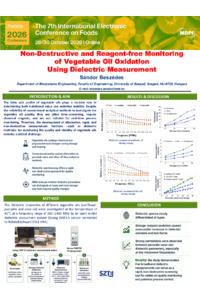
The fatty acid profile of vegetable oils, especially the ratio of saturated to unsaturated fatty acids, plays a decisive role in determining both nutritional value and oxidative stability. In most vegetable oils, the majority of fatty acids are polyunsaturated. While such a composition is favorable from a dietary perspective, it renders the oil highly susceptible to oxidation. Despite the reliability of conventional analytical methods to investigate the vegetable oil quality, they are often time-consuming, require chemical reagents, and are not suitable for real-time process monitoring. Therefore, the development of alternative, rapid, and non-destructive measurement methods –such as dielectric methods- for monitoring the quality and stability of vegetable oils remains a critical challenge.
The dielectric properties of three vegetable oils (sunflower and olive oil) were investigated at the temperature of 45°C at a frequency range of 200–2400 MHz by an open ended dielectric assessment system (Speag DAK3.5 sensor connected to Rohde&Schwarz ZVL3 VNA).
The dielectric constant (ε′) of all investigated vegetable oils was found to be consistently below 7.0 in the frequency range of 200–2400 MHz, but a systematic decrease in ε′ with increasing frequency was observed. The 40–60% decrease in dielectric constant across the investigated frequency range demonstrating a dispersive behavior. Our results show that detectable changes in dielectric parameters occur already after 6 months of storage. With increasing storage time (up to 24 months), the relationship between ε′ and ε″ evolved towards a near-linear correlation. In sunflower and olive oil a direct quantitative relationship between dielectric parameters (measured at the frequency of 400MHz) and peroxide value was found. A strong linear correlation (R2>0.8) was determined between dielectric loss factor and peroxide value , which demonstrates that dielectric measurements can act as reliable proxies for chemical oxidation parameters, and enables quantitative prediction of peroxide value at the end of the acceptable shelf-life (10 to 20 meq/kg) of vegetable oils.
Keywords
dielectric measurement
vegetable oil
peroxide value
storage
Poster
Beszedes_7thFOOD.pdf
DEVELOPMENT OF A NON-DAIRY MEDIUM FOR THE CULTIVATION OF Lacticaseibacillus paracasei.
Evaluation of Immobilisation Matrices for Phytase: Evaluation of Ionotropically Gelled Matrices