Event submissions
Published
This submission belongs to the session D. Food Microbiology & Biotechnologies of the event The 7th International Electronic Conference on Foods
Published date
23 Oct, 2026
Academic Editor
 Efstathios Giaouris
Citation
Grace Naa Ayorkor Charway, Abirami Karthikeyan, Aqib Javaid, Nazia Tabassum, Fazlurrahman Khan, Antibacterial and Antibiofilm Activity of Lactic Acid Bacteria Against Major Foodborne Pathogens: Potential for Natural Biocontrol, in Proceedings of The 7th International Electronic Conference on Foods, 28 October–30 October 2026, MDPI: Basel, Switzerland
Share
Email
Facebook
Twitter
LinkedIn
Antibacterial and Antibiofilm Activity of Lactic Acid Bacteria Against Major Foodborne Pathogens: Potential for Natural Biocontrol

Grace Naa Ayorkor Charway 1
Abirami Karthikeyan 2
Aqib Javaid 1
Nazia Tabassum 3,4

Fazlurrahman Khan 1,3,4,5,6
1. Interdisciplinary Program of Marine and Fisheries Sciences and Convergent Technology, Pukyong National University, Busan, 48513, Republic of Korea
2. Industry 4.0 Convergence Bionics Engineering, Pukyong National University, Busan, 48513, Republic of Korea
3. Research Center for Marine Integrated Bionics Technology, Pukyong National University, Busan 48513, Republic of Korea
4. Marine Integrated Biomedical Technology Center, The National Key Research Institutes in Universities, Pukyong National University, Busan 48513, Republic of Korea
5. Ocean and Fisheries Development International Cooperation Institute, Pukyong National University, Busan 48513, Republic of Korea
6. International Graduate Program of Fisheries Science, Pukyong National University, Busan, 48513, Republic of Korea
Abstract
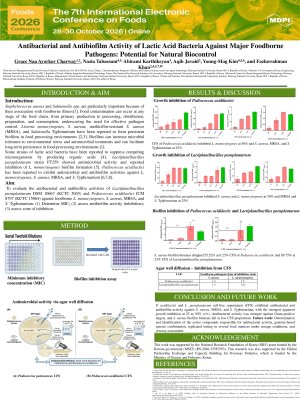
Introduction: Listeria monocytogenes, Staphylococcus aureus, methicillin-resistant S. aureus (MRSA), and Salmonella Typhimurium are frequent causes of foodborne illness. Lactic acid bacteria (LAB) offer a natural route to their control through antibacterial and antibiofilm metabolites. Two strains were tested here: Pediococcus acidilactici JCM 8797 (KCTC 15064) and Lactiplantibacillus paraplantarum DSM 10667 (KCTC 5045).
Methods: Cell-free supernatants (CFS) were collected from 24 h MRS cultures by centrifugation and 0.22 µm filtration, then mixed into pathogen growth medium at 50, 25, 12.5 and 6.25% (v/v), and growth was recorded spectrophotometrically. Assays were referenced to untreated pathogen cultures. No parallel control substituted an equal volume of sterile uninoculated MRS broth, so the share of the effect attributable to reduced nutrient availability was not measured. Clearing zones were measured on pathogen-seeded agar. Biofilm inhibition was tested against S. aureus, the strongest biofilm producer among the four, using a crystal violet assay. Cell morphology was checked by microscopy.
Results and Discussion: Both strains inhibited all four pathogens. CFS of KCTC 15064 inhibited L. monocytogenes at 50% and S. aureus, MRSA, and S. Typhimurium at 25%; KCTC 5045 inhibited S. aureus and L. monocytogenes at 50% and MRSA and S. Typhimurium at 25%. Clearing zones for KCTC 15064 measured 1.3 cm (S. aureus) and 1.5 cm (L. monocytogenes), against 1.3 cm and 2.0 cm for KCTC 5045. S. aureus biofilm biomass dropped 55.52% at 6.25% CFS of KCTC 15064 and 48.62% at 12.5% CFS of KCTC 5045. Both values include whatever contribution medium substitution made at those dilutions. Microscopy showed heavier cell wall damage in Gram-positive cells.
Conclusions: Antibacterial activity covered all four pathogens and was stronger against Gram-positive targets, and S. aureus biofilm biomass fell at low CFS proportions. Without dilution-matched medium controls, the reductions reported here set an upper estimate of CFS activity and need confirmation against sterile MRS. P. acidilactici KCTC 15064 and L. paraplantarum KCTC 5045 merit testing as biopreservatives in food matrices.
Keywords
Foodborne pathogens
Lactic acid bacteria
Antibacterial
Antibiofilm
Natural biocontrol
Poster
Grace_Charway_7th Foods Conference_Poster_21.10.26.pdf
Evaluation of Immobilisation Matrices for Phytase: Evaluation of Ionotropically Gelled Matrices
Influence of Phosphate-Induced pH Modification on Moisture Retention and Yield Characteristics of Porcine Muscle Systems