Event submissions
Published
This submission belongs to the session C. Food Physicochemistry & Analysis of the event The 7th International Electronic Conference on Foods
Published date
23 Oct, 2026
Academic Editor
 Joana S. Amaral
Citation
Bianca Francesca L Yatco, Casiana Blanca Villarino, Effects of formulation on the physicochemical properties and acceptability of a strawberry-flavored upcycled coconut skim milk (uCSM), in Proceedings of The 7th International Electronic Conference on Foods, 28 October–30 October 2026, MDPI: Basel, Switzerland
Share
Email
Facebook
Twitter
LinkedIn
Effects of formulation on the physicochemical properties and acceptability of a strawberry-flavored upcycled coconut skim milk (uCSM)

Bianca Francesca L Yatco 1

Casiana Blanca Villarino 2
1. Department of Food Science and Nutrition, College of Home Economics, University of the Philippines, Quezon City 1101, Philippines
2. Food Application and Sensory Laboratory, Department of Food Science and Nutrition, College of Home Economics, University of the Philippines-Diliman, Quezon City 1101, Philippines
Abstract
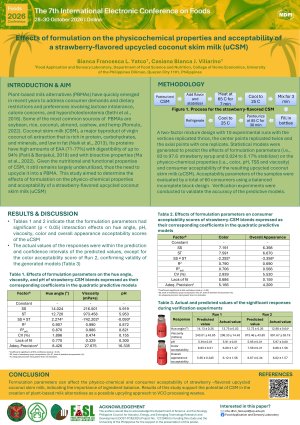
Coconut skim milk (CSM), a protein-rich by-product of virgin coconut oil processing, remains largely underutilized despite its nutritional and health functional properties. This study used a two-factor mixture design with 10 experimental runs with the vertices replicated thrice, the center points replicated twice and the axial points with one replicate. Statistical models were generated to predict the effects of formulation parameters (i.e., 83 to 97.6 strawberry syrup and 0.024 to 0.17% stabilizer) on the physico-chemical properties (i.e., color, pH, TSS and viscosity) and consumer acceptability of the resulting upcycled coconut skim milk (uCSM). Acceptability parameters of the samples were evaluated by a total of 60 consumers using a balanced incomplete block design. Verification experiments were conducted to validate the accuracy of the predictive models. Results indicate that the formulation parameters had significant (p < 0.05) interaction effects on hue angle, pH, viscosity , color and overall appearance acceptability scores of the uCSM. The hue angles of the strawberry-uCSM blends ranged from 12.49 ± 0.02° to 14.28 ± 0.05°, while the pH values ranged from 5.88 ± 0.03 to 5.99 ± 0.01. Viscosities of the samples ranged from 158.33 ± 14.43 mPa•s to 1016.67 ± 28.87 mPa•s. Color acceptability scores ranged from 4 (dislike moderately) to 9 (like extremely) while overall appearance scores ranged from 1 (dislike extremely) to 9 (like extremely). The actual values of the responses were within the prediction and confidence intervals of the predicted values confirming validity of the generated models. Results of this study support the potential of CSM in the creation of plant-based milk alternatives as a possible upcyling approach to VCO processing wastes.
Keywords
upcycled coconut skim milk
plant-based milk alternatives
physico-chemical properties
acceptability
mixture design
Poster
Foods 2026 Yatco and Villarino.pdf
Multi-omics profiling of palmitoleic acid-associated changes in Zygosaccharomyces rouxii
Glutamate and pH affect GABA production and acid stress tolerance in Levilactobacillus brevis LB12