Event submissions
Published
This submission belongs to the session D. Food Microbiology & Biotechnologies of the event The 7th International Electronic Conference on Foods
Published date
23 Oct, 2026
Academic Editor
 Efstathios Giaouris
Citation
Abirami Karthikeyan, Nazia Tabassum, Aqib Javaid, Grace Naa Ayorkor Charway, Won-Kyo Jung, Fazlurrahman Khan, Natural Bioactives Against Staphylococcus aureus: Disrupting Biofilm Formation and Virulence to Combat Food Contamination, in Proceedings of The 7th International Electronic Conference on Foods, 28 October–30 October 2026, MDPI: Basel, Switzerland
Share
Email
Facebook
Twitter
LinkedIn
Natural Bioactives Against Staphylococcus aureus: Disrupting Biofilm Formation and Virulence to Combat Food Contamination

Abirami Karthikeyan 1
Nazia Tabassum 2,3
Aqib Javaid 4
Grace Naa Ayorkor Charway 4

Won-Kyo Jung 2,3,5

Fazlurrahman Khan 2,3,4,6,7
1. Industry 4.0 Convergence Bionics Engineering, Pukyong National University, Busan, 48513, Republic of Korea
2. Marine Integrated Biomedical Technology Center, The National Key Research Institutes in Universities, Pukyong National University, Busan 48513, Republic of Korea
3. Research Center for Marine Integrated Bionics Technology, Pukyong National University, Busan 48513, Republic of Korea
4. Interdisciplinary Program of Marine and Fisheries Sciences and Convergent Technology, Pukyong Na-tional University, Busan, 48513, Republic of Korea
5. Major of Biomedical Engineering, Division of Smart Healthcare, College of Information Technology and Convergence and New-Senior Healthcare Innovation Center (BK21 Plus), Pukyong National University, Busan, Republic of Korea
6. Ocean and Fisheries Development International Cooperation Institute, Pukyong National University, Busan 48513, Republic of Korea
7. International Graduate Program of Fisheries Science, Pukyong National University, Busan, 48513, Republic of Korea
Abstract
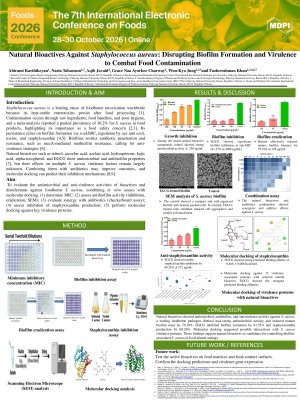
Introduction: Staphylococcus aureus, including methicillin-resistant strains (MRSA), is a major foodborne pathogen that colonizes food-contact surfaces through robust biofilm formation and produces enterotoxins implicated in staphylococcal food poisoning. In the era of smart food microbiology, harnessing natural bioactives as biotechnological tools to disrupt pathogen virulence offers a sustainable and health-aligned alternative to conventional antimicrobials.
Methods: The antibacterial and antivirulence potential of selected natural bioactives and sanitizers was systematically evaluated against S. aureus and MRSA. MICs were established by microbroth dilution. Biofilm inhibition and eradication were quantified via crystal violet staining, viable cell enumeration, and scanning electron microscopy. The carotenoid pigment staphyloxanthin, a key virulence determinant, was assessed by methanol extraction. Antibiotic-potentiating activity was evaluated through checkerboard synergy assays. Molecular docking against 15 virulence-associated protein targets was conducted using AutoDock Vina.
Results and Discussion: Benzalkonium chloride and retinol demonstrated potent antibacterial activity (MIC 2–256 µg/mL). Epigallocatechin gallate suppressed biofilm formation by 81.53% and staphyloxanthin production by 68.26%; retinol eradicated established biofilms by 79.18%. Combinations with oxacillin, rifampicin, tetracycline, and ciprofloxacin yielded synergistic or additive outcomes. Docking analyses predicted favorable binding affinities across biofilm- and pigment-regulatory proteins, supporting a multitarget biotechnological mechanism.
Conclusions: Natural bioactives with established safety profiles demonstrate strong biotechnological potential as antivirulence agents against S. aureus in food microbiology settings. Their integration into emerging food microbiological control strategies merits further validation under realistic food-matrix and processing conditions.
Keywords
Staphylococcus aureus
Foodborne pathogen
Naturally derived bioactives
Biofilm inhibition
Molecular docking.
Poster
Abirami_karthikeyan.pdf
Physico-chemical and Functional Properties of Acetylated Cocoyam Starch for use as stabilizer in Tigernut drink.
Nutritional and Functional Characterisation of Edible Leaves and Flowers from Selected Traditional Plants in Mozambique