Event submissions
Published
This submission belongs to the session B. Nutritional & Functional Foods of the event The 7th International Electronic Conference on Foods
Published date
23 Oct, 2026
Academic Editor
 Manuel Viuda-Martos
Citation
Amândio D. Zimba, Filipa A. Fernandes, Custódio Lobo Roriz, Joana Sales, Maria Jose Alves , Vitor D. Alves, Sandrina A. Heleno, Nutritional and Functional Characterisation of Edible Leaves and Flowers from Selected Traditional Plants in Mozambique, in Proceedings of The 7th International Electronic Conference on Foods, 28 October–30 October 2026, MDPI: Basel, Switzerland
Share
Email
Facebook
Twitter
LinkedIn
Nutritional and Functional Characterisation of Edible Leaves and Flowers from Selected Traditional Plants in Mozambique

Amândio D. Zimba 1,2,3
Filipa A. Fernandes 1,2
Custódio Lobo Roriz 1,2
Joana Sales 4
Maria Jose Alves 1,2

Vitor D. Alves 4

Sandrina A. Heleno 1,2
1. CIMO, Instituto Politécnico de Bragança, Campus de Santa Apolónia, 5300-253 Bragança, Portugal
2. Laboratório para a Sustentabilidade e Tecnologia em Regiões de Montanha (SusTEC), Instituto Politécnico de Bragança, Campus de Santa Apolónia, 5300-253 Bragança, Portugal
3. Escola Superior de Desenvolvimento Rural, Universidade Eduardo Mondlane, Bairro 5º Congresso, Vilankulos, Mozambique
4. LEAF - Linking Landscape, Environment, Agriculture and Food Research Centre, Laboratory Associate TERRA, Instituto Superior de Agronomia, Universidade de Lisboa, Tapada da Ajuda, 1349-017 Lisboa, Portugal
Abstract
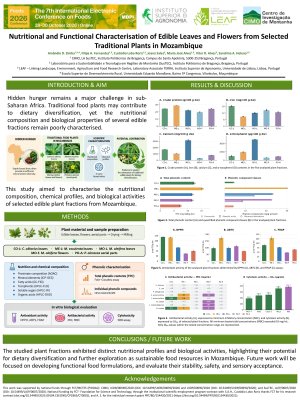
Hidden hunger remains an important nutritional challenge in sub-Saharan Africa, where diets are frequently based on staple foods with limited micronutrient diversity. Traditional food plants represent valuable resources for improving dietary quality; however, several commonly consumed fractions remain insufficiently characterised. This study evaluated the nutritional composition and biological properties of four traditional or locally available food plants from Mozambique: Corchorus olitorius, Manihot esculenta, Moringa oleifera and Portulaca oleracea. Proximate composition, mineral, fatty acids, tocopherols, soluble sugars, organic acids, and total phenolic contents were determined using standard methods. Antioxidant, antibacterial, and cytotoxic activities were also assessed in vitro tests. The results showed clear differences among species and plant fractions. M. esculenta leaves presented the highest protein content (28.99 ± 0.01 g/100 g dw), total phenolic content (15.3 ± 0.3 mg GAE/g dw), and antioxidant activity, with TEAC values of 172.6 ± 10.1 μmol TE/g dw and 128.65 ± 8.38 μmol TE/g dw for ABTS and FRAP tests, respectively. M. oleifera leaves were notable for their calcium and α-tocopherol contents, reaching 3150.1 ± 145.5 mg/100 g dw and 3727 ± 19 μg/100 g dw, respectively. C. olitorius leaves had the highest iron content, 18.3 ± 0.6 mg/100 g dw, and showed antibacterial activity against Yersinia enterocolitica with a MIC of 0.31 mg/mL. Regarding other plant parts, M. oleifera flowers exhibited considerable phenolic content and antioxidant activity, suggesting potential for valorisation. Most extracts showed low cytotoxicity, although C. olitorius leaves presented moderate antiproliferative activity against MCF-7 cells. These results support the value of traditional Mozambican food plants for dietary diversification and future food or nutraceutical applications.
Keywords
Traditional food plants; nutritional composition; bioactive compounds; antioxidant activity; hidden hunger
Poster
Foods poster 2026 A.Z.pdf
Natural Bioactives Against Staphylococcus aureus: Disrupting Biofilm Formation and Virulence to Combat Food Contamination
Interplay of vertical inheritance and horizontal gene transfer shapes biogenic amine biosynthesis in lactic acid bacteria: Implications for food safety