Event submissions
Published
This submission belongs to the session C. Food Physicochemistry & Analysis of the event The 7th International Electronic Conference on Foods
Published date
23 Oct, 2026
Academic Editor
 Joana S. Amaral
Citation
Carlos A. Ligarda-Samanez, Betsy S. Ramos-Pacheco, Rodrigo J. Guzmán Gutiérrez, Elibet Moscoso-Moscoso, Diego E. Peralta-Guevara, Henry Palomino-Rincón, David Muñoz-Huachuhuillca, Physicochemical, Bioactive, and Agroclimatic Differentiation of High-Andean Specialty Coffees Oriented toward Traceability and Territorial Valorization, in Proceedings of The 7th International Electronic Conference on Foods, 28 October–30 October 2026, MDPI: Basel, Switzerland
Share
Email
Facebook
Twitter
LinkedIn
Physicochemical, Bioactive, and Agroclimatic Differentiation of High-Andean Specialty Coffees Oriented toward Traceability and Territorial Valorization

Carlos A. Ligarda-Samanez 1,2,3

Betsy S. Ramos-Pacheco 1,2,3

Rodrigo J. Guzmán Gutiérrez 1,2,3

Elibet Moscoso-Moscoso 1,2,3

Diego E. Peralta-Guevara 1,2,3

Henry Palomino-Rincón 1,2,3
David Muñoz-Huachuhuillca 1,2,3
1. Nutraceuticals and Biomaterials Research Group, Universidad Nacional José María Arguedas, Andahuaylas 03701, Peru
2. Food Nanotechnology Research Laboratory, Universidad Nacional José María Arguedas, Andahuaylas 03701, Peru
3. Agroindustrial Engineering School, Universidad Nacional José María Arguedas, Andahuaylas 03701, Peru
Abstract
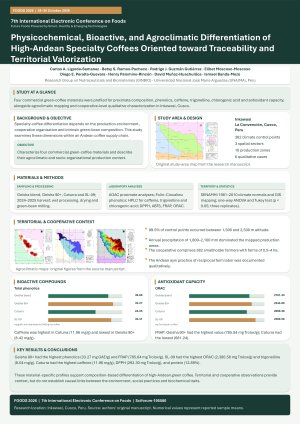
High-Andean specialty coffees exhibit compositional properties associated with origin, variety, and agroclimatic growing conditions. The objective of this study was to differentiate green coffee varieties from the Cooperativa Agraria Cafetalera Valle de Incahuasi, Peru, through physicochemical properties, bioactive compounds, instrumental color, FTIR, multivariate analysis, and agroclimatic characterization using GIS tools. The varieties known as Geisha Blend, Geisha 90+, Caturra, and SL-09 were evaluated. The results showed significant differences among varieties (p < 0.05). Moisture ranged from 9.40 to 11.24%, protein from 11.08 to 12.89%, fat from 6.93 to 8.21%, carbohydrates from 64.58 to 67.39%, and crude fiber from 23.97 to 37.32%. Geisha 90+ showed the highest crude fiber, carbohydrate, total phenolic compound content (33.27 mg GAE/g db), and luminosity (L* = 51.71). In contrast, Caturra stood out for its higher protein, fat, ash, and caffeine content (9.36 mg/g db), as well as its chromatic values a* and b*. FTIR analysis revealed spectral profiles associated with lipid, caffeine, carbonyl, chlorogenic acid, alkaloid, polysaccharide, and trigonelline functional groups, reinforcing the chemical differentiation of the evaluated coffees. PCA explained 84.32% of the total variability, confirming a clear varietal separation. GIS information allowed the delimitation of ten study zones and the generation of maps of location, roads, hydrography, slopes, vegetation cover, and altitude. These results provide technical evidence to strengthen the traceability, authenticity, and territorial valorization of High-Andean specialty coffees.
Keywords
High-Andean specialty coffee
sustainable food systems
territorial traceability
coffee valorization
bioactive compounds
physicochemical properties
agroclimatic characterization
GIS
FTIR
Coffea arabica.
Poster
FOODS2026_Poster_Cafe_Incahuasi.pdf
Interplay of vertical inheritance and horizontal gene transfer shapes biogenic amine biosynthesis in lactic acid bacteria: Implications for food safety
Comparative Biomaterial Analysis of Cellulose Produced by Caffeinated and Decaffeinated Kombucha Symbiotic Cultures of Bacteria and Yeast (SCOBY)