Event submissions
Published
This submission belongs to the session C. Food Physicochemistry & Analysis of the event The 7th International Electronic Conference on Foods
Published date
23 Oct, 2026
Academic Editor
 Joana S. Amaral
Citation
Izalin Zahari, Muhammad Shafiq Johari, Sabeetha Sarmin, Wan Nur Zahidah, Fakhri H., Effect of Extrusion Conditions and Retort Processing on the Physicochemical Properties of High-Moisture Meat Analog from Sorghum and Pea Protein Isolate, in Proceedings of The 7th International Electronic Conference on Foods, 28 October–30 October 2026, MDPI: Basel, Switzerland
Share
Email
Facebook
Twitter
LinkedIn
Effect of Extrusion Conditions and Retort Processing on the Physicochemical Properties of High-Moisture Meat Analog from Sorghum and Pea Protein Isolate

Izalin Zahari 1
Muhammad Shafiq Johari 1
Sabeetha Sarmin 1
Wan Nur Zahidah 1
Fakhri H. 1
1. Food Designing, Processing and Packaging Programme, Food Science and Technology Research Centre, Malaysian Agricultural Research and Development Institute (MARDI), Serdang, 43400 Selangor, Malaysia
Abstract
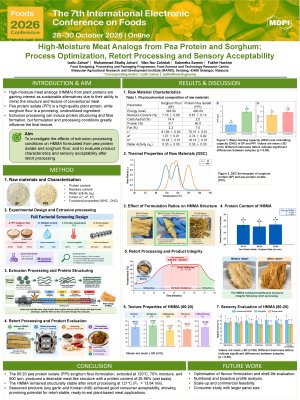
The development of high-moisture meat analogues (HMMA) from plant proteins has gained increasing attention due to their ability to mimic the structure and texture of conventional meat. This study investigated the effects of extrusion processing conditions on HMMA formulated from pea protein isolate (PPI) and sorghum flour, followed by evaluation of product stability after retort processing. A full factorial design was employed as a screening approach to evaluate the effects of PPI: sorghum flour ratios (90:10, 80:20, and 70:30), moisture content (65–70%), extrusion temperature (120–130°C), and screw speed (600–850 rpm). Raw materials were characterised for protein content, moisture content, water activity, colour, and functional properties before extrusion. Extrudates were preliminarily screened based on structural integrity, fibre formation, and overall appearance, after which the selected formulation was further characterised using instrumental texture analysis. The 80:20 (PPI: sorghum) formulation extruded at 120°C, 70% moisture, and 600 rpm produced the most desirable meat-like structure, with a protein content of 26.98% (wet basis), hardness of 454.13 g, and cutting firmness of 743.04 g. The selected HMMA was retort processed at 121°C, achieving an F₀ value of 13.84 min while maintaining satisfactory product integrity. The retort-treated HMMA was then seasoned with soy garlic and Korean chilli sauces and evaluated using a 7-point hedonic scale, achieving overall acceptability scores of 5.08 and 5.06, respectively, compared with 6.10 for the commercial HMMA reference. Overall, the study identified suitable extrusion conditions for producing a high-protein, retort-stable HMMA with promising potential for ready-to-eat plant-based meat applications.
Keywords
High-moisture meat analog
extrusion processing
physicochemical properties
plant protein
sorghum
pea protein isolate
retort processing
Poster
Foods poster -Izalin Zahari.pdf
Comparative Biomaterial Analysis of Cellulose Produced by Caffeinated and Decaffeinated Kombucha Symbiotic Cultures of Bacteria and Yeast (SCOBY)
Traditional Fermented Foods from Southern Brazil as a Source of Bacteriocinogenic Lactic Acid Bacteria against Listeria monocytogenes