Event submissions
Published
This submission belongs to the session D. Food Microbiology & Biotechnologies of the event The 7th International Electronic Conference on Foods
Published date
23 Oct, 2026
Academic Editor
 Efstathios Giaouris
Citation
Mariam NADIR, Mohamed AMELLAL, Oulayya ESSALHI, Abir EL-ARABY, Fouad ACHEMCHEM, Exploring Plant Matrices as Sources of Bioprotective Lactic Acid Bacteria for Food Applications, in Proceedings of The 7th International Electronic Conference on Foods, 28 October–30 October 2026, MDPI: Basel, Switzerland
Share
Email
Facebook
Twitter
LinkedIn
Exploring Plant Matrices as Sources of Bioprotective Lactic Acid Bacteria for Food Applications

Mariam NADIR 1
Mohamed AMELLAL 1
Oulayya ESSALHI 1
Abir EL-ARABY 1
Fouad ACHEMCHEM 1
1. Bioprocess & Environment Team, LASIME Research Laboratory, Agadir Superior School of Technology, Ibnou Zohr University, Agadir, Morocco
Abstract
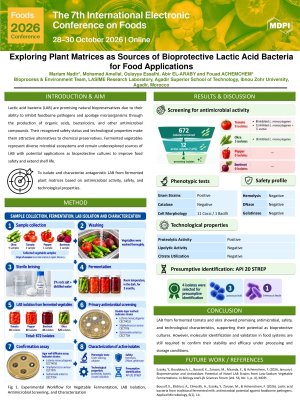
Introduction: Lactic acid bacteria (LAB) are promising natural biopreservatives due to their antimicrobial activity and the recognized safety status of many species. Fermented vegetables remain underexplored as sources of strains with potential use as bioprotective cultures. This study aimed to isolate and characterize antagonistic LAB from fermented plant matrices based on antimicrobial activity, safety, and technological properties.
Methods: LAB were isolated from fermented tomato, pepper, beetroot, and okra. A total of 672 isolates were recovered: 48 from each tomato, pepper, and beetroot sample and 528 from okra. Antimicrobial activity was initially screened using the double-layer method against Listeria monocytogenes CECT4032, Staphylococcus aureus CECT976, and Salmonella enterica CECT704, and confirmed using the agar well diffusion method. For this assay, unneutralized cell-free supernatants from the LAB were tested using Mueller–Hinton Agar and buffered semi-solid Tryptic Soy Broth. Selected isolates were characterized by Gram staining and catalase testing. Safety was assessed by hemolysis, DNase, and gelatinase assays, while technological properties included proteolytic, lipolytic, and citrate-utilizing activities. Promising isolates were presumptively identified using API 20 STREP.
Results: Among the 672 LAB isolates screened, only 12 (1.8%) exhibited reproducible antimicrobial activity. Eight tomato-derived isolates inhibited L. monocytogenes, one inhibited both L. monocytogenes and S. aureus, and three okra-derived isolates inhibited L. monocytogenes. No active isolates were recovered from pepper or beetroot. All selected isolates were Gram-positive, catalase-negative, non-hemolytic, and negative for DNase and gelatinase activities. All showed proteolytic activity but lacked lipolytic and citrate-utilizing activities. Four isolates were selected and presumptively identified as three Lactococcus lactis isolates and one Enterococcus faecalis isolate.
Conclusion: LAB from fermented tomato and okra showed promising antimicrobial, safety, and technological characteristics, supporting their potential as bioprotective cultures. However, molecular identification and validation in food systems are required to confirm their stability and efficacy under processing and storage conditions.
Keywords
Lactic acid bacteria; Antimicrobial activity; Foodborne pathogens; Fermented plant matrices; Safety assessment; Technological properties
Poster
POSTER NADIR MARIAM FOODS 2026.pdf
Traditional Fermented Foods from Southern Brazil as a Source of Bacteriocinogenic Lactic Acid Bacteria against Listeria monocytogenes
Bridging the Gap Between Traditional Knowledge and Scientific Evidence for Three Underutilised Fruits of Cabinda