Event submissions
Published
This submission belongs to the session B. Nutritional & Functional Foods of the event The 7th International Electronic Conference on Foods
Published date
23 Oct, 2026
Academic Editor
 Manuel Viuda-Martos
Citation
Luísa Dovala, Maria Cristina Cristina Duarte, Maria Manuel Romeiras, Vitor D. Alves, Margarida Moldão, Bridging the Gap Between Traditional Knowledge and Scientific Evidence for Three Underutilised Fruits of Cabinda, in Proceedings of The 7th International Electronic Conference on Foods, 28 October–30 October 2026, MDPI: Basel, Switzerland
Share
Email
Facebook
Twitter
LinkedIn
Bridging the Gap Between Traditional Knowledge and Scientific Evidence for Three Underutilised Fruits of Cabinda

Luísa Dovala 1,2
Maria Cristina Cristina Duarte 3

Maria Manuel Romeiras 1,3,4

Vitor D. Alves 1,4
Margarida Moldão 1,4
1. Linking Landscape, Environment, Agriculture and Food Research Centre (LEAF), Instituto Superior de Agronomia (ISA), Universidade de Lisboa, Tapada da Ajuda, Lisboa, 1340-017, Portugal
2. Polytechnic Institute, 11th of November University, Rua das Mangueiras, 4th of February Neighborhood, Cabinda, Angola
3. Center for Ecology, Evolution and Environmental Changes (cE3c) & CHANGE - Global Change and Sustainability Institute, Faculty of Sciences, University of Lisbon, Campo Grande, Lisboa, 1749-016, Portugal
4. Associate Laboratory TERRA, Instituto Superior de Agronomia (ISA), Universidade de Lisboa, Tapada da Ajuda, Lisboa, 1349-017, Portugal
Abstract
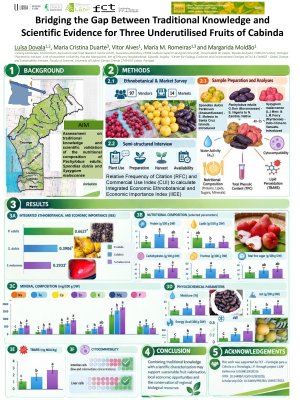
This study provides the first comprehensive assessment of traditional uses and nutritional value of Pachylobus edulis, Spondias dulcis, and Syzygium malaccense, fruits widely available in Cabinda but underutilised due to seasonality, high perishability, and limited preservation and distribution systems. Although some wild fruits have recently been characterized for Angola, Cabinda constitutes a distinct Guineo-Congolian phytogeographical unit with a markedly different floristic composition. Therefore, a dedicated ethobotanical and nutritional characterization of its underutilised fruit species can provide novel information of this region. An ethnobotanical survey was conducted in fourteen informal markets through semi-structured interviews with 97 vendors, collecting data on plant uses, preparation methods, harvest locations, and seasonal availability. Quantitative indices, including Relative Frequency of Citation (RFC) and Commercial Use Index (CUI), were used to determine the Integrated Economic and Ethnobotanical Importance Index (IIEE). The edible portions of the fruits were dehydrated by forced air at around 45ºC. Nutritional composition, total phenolic content (TPC), lipid peroxidation (TBARS) and cytocompatibility were analysed using standardized analytical methods. The IIEE index was 0.6627 for P. edulis, 0.3906 for S. dulcis, and 0.2933 for S. malaccense. The methanolic extracts exhibited protein content ranging from 3.29 to 8.67 g/100 g DW. P. edulis showed the highest lipid (52.15 ± 0.99 g/100 g DW) and TPC (54.39 ± 0.65 mg GAE/g DW) contents, whereas S. malaccense exhibited the highest potassium (1556 ± 17.1 mg/100 g DW) and total free sugar (46.88 ± 0.86 g/100 g DW) contents. TBARS values ranged from 0.044 to 2.78 mg MDA/kg, indicating differences in lipid oxidation among the fruit species. Preliminary cytocompatibility assays showed cell viability above 70% in intestinal and hepatic models at low and intermediate extract concentrations, indicating no cytotoxicity under tested conditions. Integrating traditional knowledge with scientific evidence may support future fruit valorisation strategies.
Keywords
Underutilised fruits; Nutritional composition; Bioactive compounds; Food valorisation
Poster
Sciforum-209579 Luísa Dovala.pdf
Exploring Plant Matrices as Sources of Bioprotective Lactic Acid Bacteria for Food Applications
“Adaptive Responses of Listeria monocytogenes during Long-Term Frozen Storage of Cheese: Survival and Biofilm Recovery”.