Event submissions
Published
This submission belongs to the session D. Food Microbiology & Biotechnologies of the event The 7th International Electronic Conference on Foods
Published date
23 Oct, 2026
Academic Editor
 Efstathios Giaouris
Citation
Suzette Juarez-Contreras, José Antonio Mata-Sotres, Carolina Ripollés-Ávila, Aida Hamdan-Partida, Jaime Bustos-Martínez, “Adaptive Responses of Listeria monocytogenes during Long-Term Frozen Storage of Cheese: Survival and Biofilm Recovery”., in Proceedings of The 7th International Electronic Conference on Foods, 28 October–30 October 2026, MDPI: Basel, Switzerland
Share
Email
Facebook
Twitter
LinkedIn
“Adaptive Responses of Listeria monocytogenes during Long-Term Frozen Storage of Cheese: Survival and Biofilm Recovery”.

Suzette Juarez-Contreras 1
José Antonio Mata-Sotres 2
Carolina Ripollés-Ávila 3
Aida Hamdan-Partida 4
Jaime Bustos-Martínez 4
1. Doctoral Program in Biological and Health Sciences, Metropolitan Autonomous University, Mexico City, Mexico
2. Department of Man and His Environment, Metropolitan Autonomous University–Xochimilco Campus, Calzada del Hueso 1100, Villa Quietud, Coyoacán, 04960, Mexico City, Mexico
3. Department of Animal and Food Science, Autonomous University of Barcelona, Travessera dels Turons s/n, 08193 Bellaterra, Barcelona, Spain
4. Department of Health Care, Metropolitan Autonomous University–Xochimilco Campus, Mexico City, Mexico
Abstract
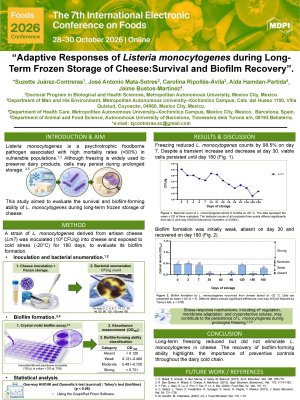
Introduction: Listeria monocytogenes causes case fatality rates of ≈30% in vulnerable population and is a psychrotrophic foodborne pathogen capable of surviving under freezing conditions. Although frozen storage is commonly used to preserve dairy products, the persistence of viable cells and their ability to recover stress-adaptive traits remain important food safety concerns. Therefore, this study aimed to evaluate the survival and biofilm-forming ability of L. monocytogenes during long-term frozen storage of cheese.
Methods: A strain of L. monocytogenes derived from artisan cheese (Lm7) was inoculated into semi-cured pasteurized cheese cubes (1g) at approximately 10⁸ CFU/g and stored at −20°C for 180 days. Survival was determined by plate counts on Oxford agar, while biofilm formation was assessed using the crystal violet microplate assay (OD595). Data were analyzed by ANOVA and Tukey’s test (p < 0.05).
Results and Discussion: Freezing caused a rapid decline in bacterial counts, reaching a 98.5% reduction after 7 days. However, viable cells remained detectable throughout storage. A transient increase in counts was observed on day 30 (1.62 × 10⁵ CFU/mL), followed by a progressive decline until day 150, when reductions of approximately 99.99% were recorded. Despite this decrease, viable populations persisted at day 180. Biofilm formation was weak during the first week, absent on day 30, and recovered at the end of storage. These findings suggest that surviving cells may retain adaptive mechanisms that facilitate persistence under prolonged cold stress.
Conclusions: Long-term frozen storage substantially reduced L. monocytogenes populations in cheese but did not eradicate the pathogen. The recovery of biofilm-forming ability after prolonged freezing highlights the importance of maintaining preventive control measures throughout the dairy cold chain.
Keywords
Listeria monocytogenes
frozen storage
cheese
biofilm formation
food safety.
Poster
Poster Foods 2026 Suzette Juárez-Contreras.pdf
Bridging the Gap Between Traditional Knowledge and Scientific Evidence for Three Underutilised Fruits of Cabinda
Phytochemical and Bioactive Properties of Ochna afzelii and Steganotaenia araliacea from Northern Angola