Event submissions
Published
This submission belongs to the session B. Nutritional & Functional Foods of the event The 7th International Electronic Conference on Foods
Published date
23 Oct, 2026
Academic Editor
 Manuel Viuda-Martos
Citation
Emília F. Vieira, Luisa Brito, Maria M. Romeiras, Ângela Fernandes, Ângela Liberal, Filipa Mandim, Tiane Finimundy, Tânia Pires, Lillian Barros, Vitor D. Alves, Phytochemical and Bioactive Properties of Ochna afzelii and Steganotaenia araliacea from Northern Angola, in Proceedings of The 7th International Electronic Conference on Foods, 28 October–30 October 2026, MDPI: Basel, Switzerland
Share
Email
Facebook
Twitter
LinkedIn
Phytochemical and Bioactive Properties of Ochna afzelii and Steganotaenia araliacea from Northern Angola

Emília F. Vieira 1,2

Luisa Brito 2

Maria M. Romeiras 2,3,4

Ângela Fernandes 5

Ângela Liberal 5

Filipa Mandim 5

Tiane Finimundy 5

Tânia Pires 5

Lillian Barros 5

Vitor D. Alves 2,3
1. National Center for Scientific Research (CNIC), MESCTI, Av. Hochi Min, Luanda, Angola
2. Linking Landscape, Environment, Agriculture and Food Research Centre (LEAF), Instituto Superior de Agronomia (ISA), Universidade de Lisboa, Tapada da Ajuda, Lisboa, 1340-017, Portugal
3. Associated Laboratory TERRA, Instituto Superior de Agronomia, University of Lisboa, Tapada da Ajuda, Lisboa, 1340-017, Portugal
4. Centre for Ecology, Evolution and Environmental Changes (cE3c) and Change–Global Change and Sustainability Institute, Faculdade de Ciências, Universidade de Lisboa, Lisboa, 1749-016, Portugal
5. Mountain Research Center (CIMO), Polytechnic Institute of Bragança (IPB), Campus Santa Apolónia, Bragança, 5300-253, Portugal
Abstract
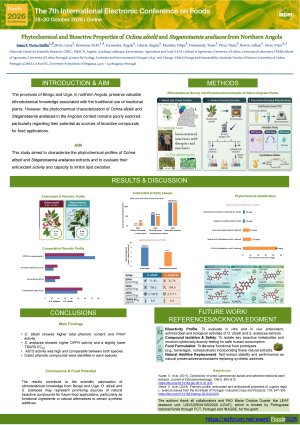
Northern Angola preserves rich ethnobotanical knowledge of medicinal plants. However, Ochna afzelii and Steganotaenia araliacea, traditionally used in Bengo and Uíge, remain poorly characterized as potential sources of bioactive compounds for food applications. This study aimed to characterize their phytochemical profiles and evaluate the antioxidant activity, inhibition of lipid oxidation, and antibacterial activity of their extracts. The samples were cleaned, dehydrated, and ground, and aqueous leaf extracts were prepared. Total phenolic content, antioxidant activity, the ability to inhibit lipid oxidation and antibacterial activity against Staphylococcus aureus, Staphylococcus epidermidis, Escherichia coli B and E. coli O157 were determined.
O. afzelii showed a total phenolic content of 4.74 mg/g of dry plant, with DPPH, FRAP, and ABTS TEAC values of 11.40, 158.2, and 2745.8 µmol Trolox/g of plant, respectively. S. araliacea showed a total phenolic content of 2.40 mg/g of dry plant, with DPPH, FRAP, and ABTS values of 22.76, 104.5, and 2717.1 µmol Trolox/g of dry plant, respectively. In the TBARS assay, S. araliacea exhibited an EC50 of 6.0 µg/mL of dry extract, compared with 8.0 µg/mL for O. afzelii. Antibacterial activity was limited under the tested conditions, with no relevant inhibition zones observed for extracts of either species. Phytochemical analysis of the O. afzelii extract identified apigenin-C-acetylhexoside and chrysoeriol-8-C-hexoside-6-C-pentoside, both at an individual concentration of 2.8 ± 0.1 mg/g dry extract. In the S. araliacea extract, 3,5-di-O-caffeoylquinic acid (45 ± 1 mg/g dry extract), malonyl di-O-caffeoylquinic acid (11.3 ± 0.3 mg/g dry extract), and quercetin-acetylhexoside (8.9 ± 0.3 mg/g dry extract) were identified.
These findings contribute to the scientific valorisation of the ethnobotanical knowledge of Bengo and Uíge and suggest that O. afzelii and S. araliacea may represent valuable sources of natural compounds for future food applications, particularly as functional ingredients or natural alternatives to certain synthetic additives.
Keywords
medicinal plants; phenolic compounds; traditional preparation; antioxidant capacity.
Poster
Sciforum-209576 Emilia-Vieira.pdf
“Adaptive Responses of Listeria monocytogenes during Long-Term Frozen Storage of Cheese: Survival and Biofilm Recovery”.
Screening Safe and Functional Lactic Acid Bacteria from Argan Press Cake for Food Biopreservation Applications.