Event submissions
Published
This submission belongs to the session D. Food Microbiology & Biotechnologies of the event The 7th International Electronic Conference on Foods
Published date
23 Oct, 2026
Academic Editor
 Efstathios Giaouris
Citation
Oulayya Essalhi, Mariam Nadir, Said El Hizazi, Fouad Achemchem, Screening Safe and Functional Lactic Acid Bacteria from Argan Press Cake for Food Biopreservation Applications., in Proceedings of The 7th International Electronic Conference on Foods, 28 October–30 October 2026, MDPI: Basel, Switzerland
Share
Email
Facebook
Twitter
LinkedIn
Screening Safe and Functional Lactic Acid Bacteria from Argan Press Cake for Food Biopreservation Applications.

Oulayya Essalhi 1
Mariam Nadir 1
Said El Hizazi 1
Fouad Achemchem 1
1. LASIME Research Laboratory, Bioprocess & Environment Team, Agadir Superior School of Technology, Ibn Zohr University, Agadir- Morocco
Abstract
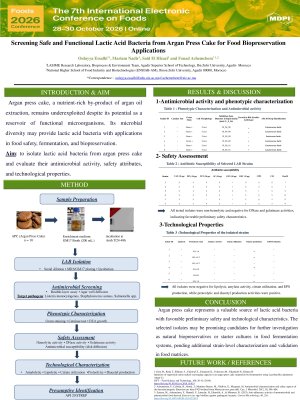
Introduction: Argan press cake, a nutrient-rich by-product of argan oil extraction, remains underexploited despite its potential as a reservoir of functional microorganisms. Its microbial diversity may provide lactic acid bacteria with applications in food safety, fermentation, and biopreservation. This study aimed to isolate lactic acid bacteria from argan press cake and evaluate their antimicrobial activity, safety attributes, and technological properties.
Methods: 480 bacterial isolates were recovered from 10 argan press cake samples. Antagonistic activity was screened by double-layer and agar well diffusion against Listeria monocytogenes CECT 4032, Staphylococcus aureus CECT 976, and Salmonella spp. CECT 704. Inhibition zones and active isolates were recorded. Assays used anaerobic conditions and buffered MRS and GM17 (pH 6.5) to minimize the contribution of hydrogen peroxide and organic acids to the observed antimicrobial activity. Safety assessment comprised hemolytic, DNase, and gelatinase activities, together with antimicrobial susceptibility determined by the disk diffusion method. Technological characterization covered amylolytic, lipolytic, citrate-utilizing, proteolytic, and diacetyl-producing activities. Isolates were presumptively identified using API 20 STREP.
Results: Among the 480 isolates, 28 showed activity against L. monocytogenes (12–20 mm), while 6 were active against S. aureus (15–17 mm); no activity was observed against Salmonella spp. All selected isolates were Gram-positive, catalase-negative, non-hemolytic, and negative for DNase and gelatinase. Most isolates were susceptible to the tested antibiotics; resistance was mainly observed against kanamycin (9/28), one isolate was resistant to vancomycin, and 18/28 showed intermediate susceptibility to gentamicin. Most isolates showed proteolytic and diacetyl-producing activities, whereas amylolytic, lipolytic, and citrate-utilizing activities were absent. Seven isolates were presumptively identified as Lactococcus lactis.
Conclusion: Argan press cake represents a valuable source of lactic acid bacteria with favorable preliminary safety and technological characteristics. The selected isolates may be promising candidates for further investigation as natural biopreservatives or starter cultures in food fermentation systems, pending additional strain-level characterization and validation in food matrices.
Keywords
Argan press cake
lactic acid bacteria
Lactococcus lactis
antimicrobial activity
food biopreservation
safety assessment.
Poster
Foods2026 poster 1 .pdf
Phytochemical and Bioactive Properties of Ochna afzelii and Steganotaenia araliacea from Northern Angola
Therapeutic Potential of Oleuropein and Hydroxytyrosol against Obesity Comorbidities: A Systematic Review