Event submissions
Published
This submission belongs to the session D. Food Microbiology & Biotechnologies of the event The 7th International Electronic Conference on Foods
Published date
23 Oct, 2026
Academic Editor
 Efstathios Giaouris
Citation
Diogo Lucas Pinheiro, Cátia Morgado, Mafalda Alexandra Silva, Patrícia Bernardo, Helena S. Costa, Carlos Brandão, Tânia Gonçalves Albuquerque, Exploring the use of Aspergillus oryzae for the development of innovative fish-based sausages, in Proceedings of The 7th International Electronic Conference on Foods, 28 October–30 October 2026, MDPI: Basel, Switzerland
Share
Email
Facebook
Twitter
LinkedIn
Exploring the use of Aspergillus oryzae for the development of innovative fish-based sausages

Diogo Lucas Pinheiro 1
Cátia Morgado 1,2
Mafalda Alexandra Silva 3,4
Patrícia Bernardo 1,5

Helena S. Costa 3,4
Carlos Brandão 1,2

Tânia Gonçalves Albuquerque 1,4
1. Estoril Higher Institute for Tourism and Hotel Studies; Estoril, 2769-510 Estoril, Portugal
2. Centre for Tourism Research, Development and Innovation (CiTUR) Estoril, 2769-510 Estoril, Portugal
3. Department of Food and Nutrition, National Institute of Health Dr. Ricardo Jorge, Lisbon, 1649-016 Lisbon, Portugal
4. REQUIMTE-LAQV/Faculty of Pharmacy, University of Porto, Porto, 4050-313 Porto, Portugal
5. Center for Interdisciplinary Research in Animal Health (CIISA) Faculty of Veterinary Medicine, University of Lisbon, 1300-477 Lisbon, Portugal
Abstract
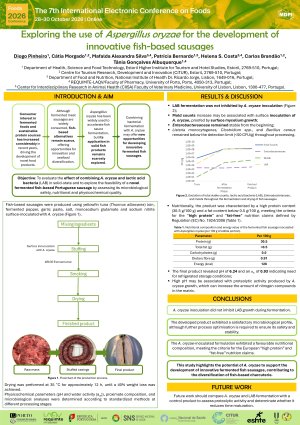
Introduction: Consumer interest in fermented foods and sustainable protein sources has increased considerably in recent years, driving the development of novel food products. Although fermented meat sausages are widely consumed, fermented fish-based alternatives remain scarce. This study explored the use of Aspergillus oryzae during the production of an innovative Portuguese-style fish-based sausage and evaluated its microbiological, physicochemical, and nutritional characteristics.
Methods: Fish-based sausages were produced using yellowfin tuna (Thunnus albacares) and surface-inoculated with A. oryzae. After fermentation and dehydration until approximately 40% weight loss, physicochemical parameters (pH and water activity), proximate composition, and microbiological analyses were determined according to standardized methods at different processing stages.
Results: Nutritionally, the product was characterized by a high protein content (30.5 g/100 g) and a fat content below 0.5 g/100 g, meeting the criteria for the “high protein” and “fat-free” nutrition claims defined by European legislation (Regulation (EC) No. 1924/2006). Physicochemical analysis showed a pH of 6.24 and an aw of 0.926, indicating the need for refrigerated storage. Mesophilic aerobic counts increased by 2.4 log CFU/g after fermentation and remained stable thereafter. Mould counts increased by 4.3 log CFU/g in the final product, which may be associated with the inoculation of the product. Lactic acid bacteria increased by 3.8 log CFU/g, while yeast counts decreased throughout processing. Enterobacteriaceae levels remained stable from the beginning, and Listeria monocytogenes, Clostridium spp., and Bacillus cereus remained below the detection limit (<50 CFU/g).
Conclusions: The results demonstrate the feasibility of using A. oryzae during the production of an innovative fish-based sausage. The developed product exhibited a satisfactory microbiological profile and a favorable nutritional composition, meeting the criteria for the European “high protein” and “fat-free” nutrition claims, thereby supporting its potential as an innovative and sustainable alternative to conventional fermented sausages.
Keywords
Aspergillus Oryzae
Nutritional Composition
Microbiological quality
Fish-based sausage
Thunnus albacares
Poster
Poster Foods A. Oryzae.pdf
Therapeutic Potential of Oleuropein and Hydroxytyrosol against Obesity Comorbidities: A Systematic Review
Response Surface Optimization of Goat Milk Kefir Fermentation for Improved Physicochemical and Microbiological Quality