Event submissions
Published
This submission belongs to the session D. Food Microbiology & Biotechnologies of the event The 7th International Electronic Conference on Foods
Published date
23 Oct, 2026
Academic Editor
 Efstathios Giaouris
Citation
Mohamed AMELLAL, Mariem ZANZAN, Mariam NADIR, Youssef EZZAKY, Fouad ACHEMCHEM, Response Surface Optimization of Goat Milk Kefir Fermentation for Improved Physicochemical and Microbiological Quality, in Proceedings of The 7th International Electronic Conference on Foods, 28 October–30 October 2026, MDPI: Basel, Switzerland
Share
Email
Facebook
Twitter
LinkedIn
Response Surface Optimization of Goat Milk Kefir Fermentation for Improved Physicochemical and Microbiological Quality

Mohamed AMELLAL 1
Mariem ZANZAN 1
Mariam NADIR 1

Youssef EZZAKY 1
Fouad ACHEMCHEM 1
1. Bioprocess & Environment Team, LASIME Research Laboratory, Agadir Superior School of Technology, Ibnou Zohr University, Agadir, Morocco
Abstract
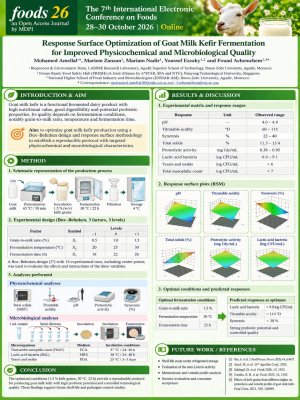
Introduction: Goat milk kefir is gaining increasing attention as a functional fermented dairy product because of its digestibility, nutritional value, and potential probiotic properties. However, its quality is strongly influenced by fermentation conditions, including grain-to-milk ratio, temperature, and fermentation time. This study aimed to optimize goat milk kefir production using a Box–Behnken design combined with response surface methodology to establish a reproducible protocol with targeted physicochemical and microbiological characteristics.
Methods: A three-factor, three-level Box–Behnken design comprising 14 experimental runs, including center points, was applied. The independent variables were grain-to-milk ratio, fermentation temperature, and fermentation time. The evaluated responses included pH, titratable acidity, syneresis, total solids, proteolytic activity, lactic acid bacteria, yeasts and molds, and total aerobic mesophilic count. Data were analyzed by ANOVA and fitted to second-order polynomial models to determine the effects of fermentation parameters and identify optimal processing conditions.
Results: All three factors significantly affected kefir quality. The experimental ranges were pH 4.0–4.9, titratable acidity 60–115 °D, syneresis 22–40%, total solids 11.3–13.4%, proteolytic activity 0.38–0.95 mg Gly/mL, and lactic acid bacteria 6.9–9.1 log CFU/mL. Increasing grain-to-milk ratio and temperature accelerated acidification and microbial growth, whereas longer fermentation enhanced proteolysis. The optimized region achieved LAB counts above 9.0 log CFU/mL, titratable acidity above 110 °D, and syneresis below 30%.
Conclusions: The optimized conditions, namely 1.5% kefir grains, 30 °C, and 22 h, provide a reproducible protocol for producing goat milk kefir with strong probiotic potential and controlled technological quality. These conditions may support future shelf-life and pathogen-control studies.
Keywords
goat milk kefir
fermentation optimization
Box–Behnken design
response surface methodology
lactic acid bacteria
functional fermented dairy.
Poster
AMELLAL_Foods2026_Conference_Poster.pdf
Exploring the use of Aspergillus oryzae for the development of innovative fish-based sausages
Tailoring of Hydrophobic NADESs Acidity and Viscosity on the Stabilization and HPLC Analysis of Portulaca oleracea L. Leaves Labile Bioactives