Event submissions
Published
This submission belongs to the session C. Food Physicochemistry & Analysis of the event The 7th International Electronic Conference on Foods
Published date
23 Oct, 2026
Academic Editor
 Joana S. Amaral
Citation
Tarik Sebbah, Edite Cunha, M. Conceição Montenegro, Tailoring of Hydrophobic NADESs Acidity and Viscosity on the Stabilization and HPLC Analysis of Portulaca oleracea L. Leaves Labile Bioactives, in Proceedings of The 7th International Electronic Conference on Foods, 28 October–30 October 2026, MDPI: Basel, Switzerland
Share
Email
Facebook
Twitter
LinkedIn
Tailoring of Hydrophobic NADESs Acidity and Viscosity on the Stabilization and HPLC Analysis of Portulaca oleracea L. Leaves Labile Bioactives

Tarik Sebbah 1,2,3
Edite Cunha 2

M. Conceição Montenegro 2
1. Pathological Experimental Research Laboratory (PERL), Faculty of Medicine, Hassiba Benbouali University of Chlef, Hay Essalem 02000, Chlef, Algeria
2. LAQV/REQUIMTE, Department of Chemical Sciences, Faculty of Pharmacy, University of Porto, R. Jorge de Viterbo Ferreira 228, 4050-313 Porto, Portugal
3. Laboratoire de Nutrition Clinique et Métabolique, Université Oran 1 Ahmed Benbella, BP 1524 El M’Naouer 31000 Oran. Algérie.
Abstract
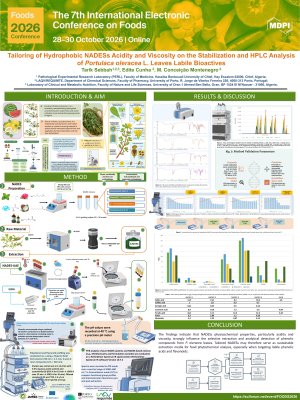
Purslane (Portulaca oleracea L.) is a rich source of phenolic acids and flavonoids, although several of these compounds are chemically labile during extraction and analysis. Natural deep eutectic solvents (NADESs) represent tunable and more sustainable alternatives to conventional organic solvents; however, the influence of NADESs acidity and viscosity on the selective recovery of purslane phenolics remains insufficiently explored.
This study evaluated the effect of acidic and monoterpenoid-based NADESs on the ultrasound-assisted extraction and HPLC-DAD profiling of phenolic compounds from purslane leaves.
Four NADESs formulations based on menthol, β-citronellol, lactic acid, capric acid, and acetic acid were prepared by heating and stirring. Systems were characterized for pH and viscosity (at 40°C): me/la (pH 1.07; 29.10 mPa·s), me/β-c (pH 3.85; 16 mPa·s), β-c/ca (pH 3.38; 10 mPa·s), and me/aa (pH 1.99; viscosity undetectable). After ultrasound-assisted extraction under standardized conditions, phenolic compounds were quantified by HPLC-DAD and compared with an ethanol extract used as a conventional control.
Chromatographic analysis revealed strong, subclass-specific affinities. Highly acidic, lower-viscosity NADES exhibited superior flavonoid yields: me/aa achieved the highest recovery of rutin (8.28 mg/g) and quercetin (6.12 mg/g), followed by me/la acid (6.30 mg/g rutin; 5.40 mg/g quercetin). In contraste monoterpenoid-based me/β-c NADES demonstrated a distinct selectivity profile, yielding significantly higher concentrations of phenolic acids (coumaric, syringic, caffeic, and gallic). Several compounds detected in NADESs extracts, including rutin, quercetin, caffeic acid, and syringic acid, were not detected in the ethanol extract under the same analytical conditions, suggesting improved recovery and/or protection of labile phenolics in the eutectic matrices.
The findings indicate that NADESs physicochemical properties, particularly acidity and viscosity, strongly influence the selective extraction and analytical detection of phenolic compounds from P. oleracea leaves. Tailored NADESs may therefore serve as sustainable extraction media for food phytochemical analysis, especially when targeting labile phenolic acids and flavonoids.
Keywords
Purslane leaves
eutectic matrices
monoterpenoids
carboxylic acids
labile flavonoids.
Poster
FOODS 2026_Impact of Hydrophobic NADES Acidity and Viscosity on the Stabilization and High-Performance Liquid Chromatography Analysis of Purslane Leaf Antioxidants.pdf
Response Surface Optimization of Goat Milk Kefir Fermentation for Improved Physicochemical and Microbiological Quality
Impact of fruit and vegetable enrichment on functional profile and sensory acceptance of yogurts