Event submissions
Published
This submission belongs to the session D. Food Microbiology & Biotechnologies of the event The 7th International Electronic Conference on Foods
Published date
23 Oct, 2026
Academic Editor
 Efstathios Giaouris
Citation
Rita Vedor, Maria Leonor Fonseca, Célia Batalha, Maria Ribeiro, Gustavo Fidalgo, Rodrigo Campos, Daniela Machado, José Carlos Andrade, Ana Maria Gomes, From Fruit Waste to Functional Ingredients: Probiotic Growth Promoting and Bioactive Potential of Rejected Plum and Orange Pulp, in Proceedings of The 7th International Electronic Conference on Foods, 28 October–30 October 2026, MDPI: Basel, Switzerland
Share
Email
Facebook
Twitter
LinkedIn
From Fruit Waste to Functional Ingredients: Probiotic Growth Promoting and Bioactive Potential of Rejected Plum and Orange Pulp

Rita Vedor 1
Maria Leonor Fonseca 1
Célia Batalha 1
Maria Ribeiro 1
Gustavo Fidalgo 1
Rodrigo Campos 1

Daniela Machado 1

José Carlos Andrade 2,3

Ana Maria Gomes 1
1. Universidade Católica Portuguesa, CBQF—Centro de Biotecnologia e Química Fina—Laboratório Associado, Escola Superior de Biotecnologia, Rua Diogo Botelho 1327, 4169-005 Porto, Portugal
2. Associate Laboratory i4HB-Institute for Health and Bioeconomy, University Institute of Health Sciences-CESPU, 4585-116 Gandra, Portugal.
3. UCIBIO-Applied Molecular Biosciences Unit, Translational Toxicology Research Laboratory, University Institute of Health Sciences (1H-TOXRUN, IUCS-CESPU), 4585-116 Gandra, Portugal.
Abstract
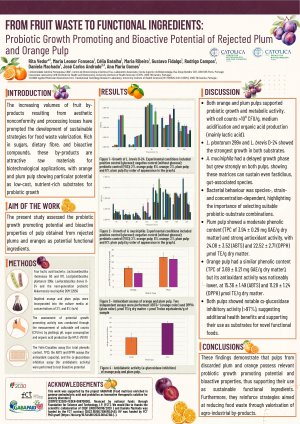
The increasing volumes of fruit by-products resulting from aesthetic nonconformity and processing losses have prompted the development of sustainable strategies for the valorisation of food waste. The present study assessed the probiotic growth promoting potential and bioactive properties of pulp obtained from rejected plums and oranges as potential functional ingredients. Both pulps were incorporated into culture media at concentrations of 2% and 6% (w/v) and tested for their capacity to support the growth and metabolic activity of five probiotic strains, including four lactic acid bacteria (Lacticaseibacillus rhamnosus GG and R11, Lactiplantibacillus plantarum299v, Levilactobacillus brevis D-24) and the next-generation probiotic Akkermansia muciniphila DSM 22959. The assessment of potential growth promoting activity was conducted through the measurement of culturable cell counts, pH, sugar consumption, and organic acid production. The Folin-Ciocalteu assay (for total phenolic content, TPC), the ABTS and DPPH assays (for antioxidant capacity), and the α-glucosidase inhibition assay (for antidiabetic activity) were performed to test for additional bioactive potential. The pulps of both fruits supported probiotic growth and metabolic activity, as evidenced by increased cell counts ( >108 CFU/g), medium acidification, and organic acid production (mainly lactic acid). The TPC of plum pulp was found to be 3.94 ± 0.29 mg GAE/gdry matter, with antioxidant activities measuring 24.08 ± 3.52 (ABTS) and 22.52 ± 2.71 (DPPH) µmol TE/gdry matter. In the case of orange pulp, the TPC was 3.69 ± 0.21 mg GAE/gdry matter, with antioxidant activities measuring 15.36 ± 1.49 (ABTS) and 11.28 ± 1.24 (DPPH) µmol TE/gdry matter. Furthermore, both pulps demonstrated notable α-glucosidase inhibitory activity, with values exceeding 97%. These findings demonstrate that pulps from discarded plum and orange possess relevant probiotic growth promoting potential and bioactive properties, thus supporting their use as sustainable functional ingredients. Furthermore, they reinforce strategies aimed at reducing food waste through valorisation of agro-industrial by-products.
Keywords
Potential prebiotic activity
Probiotics
bioactive potential
Food waste valorisation
Functional ingredient
Poster
Foods Electronic Conference_Rita Vedor.pdf
Impact of fruit and vegetable enrichment on functional profile and sensory acceptance of yogurts
THERMAL WATER-ASSISTED PRODUCTION OF SHELL-ENRICHED FLOUR FROM NON-MARKETABLE PORTUGUESE CHESTNUTS