Event submissions
Published
This submission belongs to the session D. Food Microbiology & Biotechnologies of the event The 7th International Electronic Conference on Foods
Published date
23 Oct, 2026
Academic Editor
 Arun K. Bhunia
Citation
Maria João Nunes, Lucia Noronha, Maria Inês Cruz, Miguel Teixeira, Fátima Carvalho, Paula Teixeira, Impact of nitrite reduction in cooked turkey ham: preliminary studies on safety issues, in Proceedings of The 7th International Electronic Conference on Foods, 28 October–30 October 2026, MDPI: Basel, Switzerland
Share
Email
Facebook
Twitter
LinkedIn
Impact of nitrite reduction in cooked turkey ham: preliminary studies on safety issues

Maria João Nunes 1
Lucia Noronha 2
Maria Inês Cruz 3
Miguel Teixeira 2
Fátima Carvalho 3
Paula Teixeira 1
1. Universidade Católica Portuguesa, CBQF - Centro de Biotecnologia e Química Fina – Laboratório Associado, Escola Superior de Biotecnologia, Rua Diogo Botelho 1327, 4169-005 Porto, Portugal
2. Associação Colab4Food, Rua dos Lagidos, 4485-655, Vairão, Portugal
3. Primor – Charcutaria Prima, S. A., Avenida de Santiago de Gavião 1142, 4760-003 Vila Nova de Famalicão, Portugal
Abstract
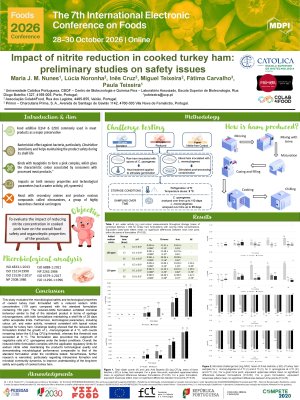
Sodium nitrite is a preservative widely used in the meat industry to ensure product quality and safety by inhibiting the growth of pathogenic microorganisms and preventing spoilage. Cooked turkey ham commonly contains nitrite; however concerns regarding its potential health effects have prompted regulatory changes in Europe, reducing the maximum permitted level from 150 mg/kg to 80 mg/kg (expressed in nitrite ions, corresponding to 119 mg/kg of sodium nitrite) in meat products. This study aimed to evaluate the impact of nitrite reduction on the microbiological safety and organoleptic characteristics of cooked turkey ham.
Total viable counts (TVC), lactic acid bacteria (LAB), Enterobacteriaceae, Escherichia coli, and Staphylococcus aureus as well as pathogenic bacteria, including Listeria monocytogenes, Salmonella spp., and sulphite-reducing Clostridium spores, were determined according to ISO standards in cooked turkey ham produced with different nitrite concentrations throughout its shelf life. Physico-chemical analysis, including colour, water activity (aw) and pH were evaluated at 0, 17, and 35 days of storage. Challenge testing was performed with both L. monocytogenes and C. sporogenes (as a surrogate for C. botulinum), during 35 and 264 days, respectively, under refrigerated storage (4 ºC) and abuse storage temperature (8 ºC).
Microbiological analyses demonstrated that the reduced-nitrite product showed trends in TVC and LAB growth similar to those of the standard product, with counts remaining below 1.0 x 10⁷ CFU/g throughout 28 days of storage at 4 °C and no detection of pathogenic bacteria, in line with microbiological safety criteria. Overall, no significant differences were observed in physico-chemical properties during the shelf life of the product. Challenge testing results indicate that the reduced-nitrite formulation limited the growth of L. monocytogenes remaining below the 0.5 log CFU/g threshold at 4 °C but showing an increase above this threshold at 8 °C, and prevented vegetative outgrowth of C. sporogenes under the tested conditions.
These findings suggest that nitrite reduction does not adversely affect the safety or quality of cooked turkey ham under the conditions studied. Nevertheless, additional research is required to further confirm the long-term safety of reduced-nitrite formulations.
Keywords
nitrite
pathogenic
L.monocytogenes
Clostridium sporogenes
turkey ham
Poster
Foods poster.pdf
THERMAL WATER-ASSISTED PRODUCTION OF SHELL-ENRICHED FLOUR FROM NON-MARKETABLE PORTUGUESE CHESTNUTS
The effect of fenugreek seeds addition on selected quality characteristics of hamburgers