Event submissions
Published
This submission belongs to the session B. Nutritional & Functional Foods of the event The 7th International Electronic Conference on Foods
Published date
23 Oct, 2026
Academic Editor
 Manuel Viuda-Martos
Citation
Fathima Sapra, Dilshani Dissanayaka, Pathirage Kamal Perera, Mustafa Inul Manuha, Nimal Punyasiri, Quantification of Anthocyanins in Red Cabbage (Brassica oleracea var. capitata f. rubra) Leaf Powder and Their Potential Implications for Neuroprotection, in Proceedings of The 7th International Electronic Conference on Foods, 28 October–30 October 2026, MDPI: Basel, Switzerland
Share
Email
Facebook
Twitter
LinkedIn
Quantification of Anthocyanins in Red Cabbage (Brassica oleracea var. capitata f. rubra) Leaf Powder and Their Potential Implications for Neuroprotection

Fathima Sapra 1
Dilshani Dissanayaka 2
Pathirage Kamal Perera 3
Mustafa Inul Manuha 1
Nimal Punyasiri 4
1. Department of Unani Pharmacology, Faculty of Indigenous Medicine, University of Colombo, Colombo, Sri Lanka
2. Department of Physiology, Faculty of Medicine, University of Colombo, Colombo, Sri Lanka
3. Department of Ayurveda Pharmacology, Pharmaceutics and and Community Medicine, University of Colombo, Colombo, Sri Lanka
4. Institute of Biochemistry, Molecular Biology & Biotechnology (IBMBB), University of Colombo, Colombo, Sri Lanka
Abstract
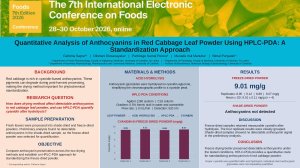
Anthocyanins flavonoid pigments abundant in red cabbage (Brassica oleracea var. capitata f. rubra) exhibit potent antioxidant anti-inflammatory and neuroprotective properties relevant to Parkinson’s disease pathology. However their instability during post-harvest processing limits therapeutic potential. This study evaluates drying method effects and quantifies cyanidin as a stable marker of anthocyanin content for neuroprotective relevance In red cabbage leaf powders, processed by shade drying and freeze-drying preservation.Efficiency was comparatively assessed with emphasis on neuroprotective phytochemical standardization for Parkinson’s disease applications research translation context.Fresh red cabbage leaves were processed into shade-dried and freeze-dried powders Preliminary analysis showed loss of anthocyanin detectability in shade-dried samples indicating degradation.Thus freeze-dried samples were selected for quantitative analysis Anthocyanins were acid hydrolysed to convert cyanidin glycosides into cyanidin aglycone simplifying chromatographic profiling. HPLC-PDA analysis was performed using Agilent 1260 system with C18 column and gradient elution of 0.5% formic acid in water and acetonitrile at 1.0 mL/min detecting cyanidin at 520 nm across replicate measurements ensuring analytical reliability and method reproducibility for phytochemical standardization purposes.Freeze-dried samples showed consistent cyanidin levels across four replicates 8.95 9.12 8.89 and 9.07 mg/g with a mean of approximately 9.01 mg/g indicating strong reproducibility and effective preservation.In contrast shade-dried samples exhibited complete loss of detectable anthocyanins Acid hydrolysis enabled conversion of multiple glycosidic forms into a single cyanidin peak improving analytical clarity significantly enhancing precision analysis.Freeze-drying effectively preserved anthocyanins whereas shade drying caused complete degradation of neuroprotective phytochemicals in red cabbage. The quantified cyanidin supports red cabbage as a functional food candidate relevant to Parkinson’s disease through modulation of oxidative stress and inflammatory pathways. The HPLC-PDA method provides robust standardization for neuroprotective nutraceutical development and research applications.
Keywords
Red cabbage
Anthocyanins
Cyanidin
Neuroprotection
Parkinson’s disease
Poster
Dr MSF Sapra- E poster -Foods2026.pdf
The effect of fenugreek seeds addition on selected quality characteristics of hamburgers
Shelf life extension of Ready-to-Eat glasswort through natural antimicrobials and Modified Atmosphere Packaging