Event submissions
Published
This submission belongs to the session D. Food Microbiology & Biotechnologies of the event The 7th International Electronic Conference on Foods
Published date
23 Oct, 2026
Academic Editor
 Efstathios Giaouris
Citation
Angela Guerrieri, Annalisa d'Amelio, Clelia Altieri, Anna Bonasia, Luigi Giuseppe Duri, Antonio Elia, Giulia Conversa, Barbara Speranza, Maria Rosaria Corbo, Shelf life extension of Ready-to-Eat glasswort through natural antimicrobials and Modified Atmosphere Packaging, in Proceedings of The 7th International Electronic Conference on Foods, 28 October–30 October 2026, MDPI: Basel, Switzerland
Share
Email
Facebook
Twitter
LinkedIn
Shelf life extension of Ready-to-Eat glasswort through natural antimicrobials and Modified Atmosphere Packaging

Angela Guerrieri 1
Annalisa d'Amelio 1
Clelia Altieri 1
Anna Bonasia 1
Luigi Giuseppe Duri 1

Antonio Elia 1

Giulia Conversa 1

Barbara Speranza 1
Maria Rosaria Corbo 1
1. Department of the Science of Agriculture, Food, Natural Resources and Engineering, University of Foggia, Via Napoli 25, Foggia, Italy
Abstract
Introduction
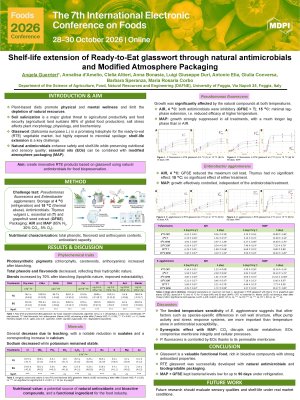
Salicornia spp. are halophytic plants of considerable interest for the food sector, valued for their rich phytochemical profile and their capacity to grow on marginal, salt-impacted soils where conventional crops cannot thrive. Despite this potential, their transformation into ready-to-eat (RTE) vegetable products remains underexplored. This study aimed to develop and evaluate a novel RTE product based on glasswort harvested in the Apulia region (Southern Italy), integrating nutritional analysis, natural preservation technologies, and consumer perception.
Methods
Fresh glasswort samples were characterized for their phenolic and flavonoid content. The effect of blanching on bioactive compounds, oxalate levels, and mineral bioavailability was assessed. For preservation, two natural antimicrobials (thyme essential oil T and grapefruit seed extract GFSE) were tested under ordinary and modified atmosphere packaging (MAP). A microbiological challenge test using Pseudomonas fluorescens and Enterobacter agglomerans was performed at 4°C and 15°C over 90 days. Consumer acceptance was evaluated through a survey of 129 participants.
Results
Fresh samples contained 2648 mg GAE 100 g⁻¹ dw of total phenols and 413 mg QE 100 g⁻¹ dw of total flavonoids. Blanching reduced total phenols and flavonoids by approximately 40% and 26%, respectively, while retaining significant bioactive levels. Oxalate content decreased by ~53% following blanching, while calcium concentration increased, suggesting enhanced mineral bioavailability. GFSE exhibited stronger antimicrobial activity than thyme essential oil; the MAP + GFSE combination was the most effective, keeping bacterial loads below 5 log CFU g⁻¹ throughout 90 days at 4°C. Both antimicrobials reduced yellowing during storage. Consumer evaluation revealed that 82.2% of respondents expressed willingness to try the product.
Conclusions
The developed RTE glasswort product demonstrates strong nutritional value and promising shelf life under optimized preservation conditions, particularly MAP combined with GFSE. High consumer interest in its nutritional attributes supports the commercial viability of glasswort-based products, positioning them as a sustainable and marketable innovation in the functional food sector.
Keywords
glasswort
halophyte
ready-to-eat vegetables
essential oils
shelf-life extension
Poster
Poster_Foods2026_Guerrieri Angela.pdf
Quantification of Anthocyanins in Red Cabbage (Brassica oleracea var. capitata f. rubra) Leaf Powder and Their Potential Implications for Neuroprotection
Bio-Prospecting and Probiotic Characterization of Lactic Acid Bacteria Isolated from Milk and Dahi of Indigenous Badri and Malnad Gidda Cattle of India