Event submissions
Published
This submission belongs to the session D. Food Microbiology & Biotechnologies of the event The 7th International Electronic Conference on Foods
Published date
23 Oct, 2026
Academic Editor
 Efstathios Giaouris
Citation
Lakshith P C, Rashmi H.M., Basavaprabhu H.N., Bio-Prospecting and Probiotic Characterization of Lactic Acid Bacteria Isolated from Milk and Dahi of Indigenous Badri and Malnad Gidda Cattle of India, in Proceedings of The 7th International Electronic Conference on Foods, 28 October–30 October 2026, MDPI: Basel, Switzerland
Share
Email
Facebook
Twitter
LinkedIn
Bio-Prospecting and Probiotic Characterization of Lactic Acid Bacteria Isolated from Milk and Dahi of Indigenous Badri and Malnad Gidda Cattle of India

Lakshith P C 1
Rashmi H.M. 1
Basavaprabhu H.N. 1
1. Dairy Microbiology Lab, Southern Regional Station, ICAR-National Dairy Research Institute, Adugodi, Bengaluru-560030, Karnataka, India.
Abstract
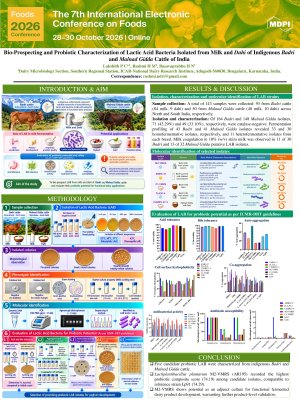
The exploration of indigenous dairy ecosystems offers significant opportunities for the discovery of novel lactic acid bacteria (LAB) with probiotic and techno-functional properties suitable for functional foods and fermented dairy products. This study aimed to isolate, characterize, and evaluate LAB from milk and dahi obtained from two indigenous Indian cattle breeds, Badri cattle of the Himalayan region and Malnad Gidda cattle of the Western Ghats. A total of 107 samples, comprising 95 milk and 12 dahi samples, were collected, including 80 samples from Badri cattle and 27 samples from Malnad Gidda cattle. From these samples, 203 bacterial isolates were recovered, of which 65 were identified as presumptive LAB based on morphological and biochemical characteristics.
Thirty representative LAB isolates were initially screened for starter culture potential through assessment of milk coagulation, pH reduction, and acid production. Five promising isolates, namely M2-VMRS (Lactiplantibacillus plantarum AR195), C1-VMRS (Lactiplantibacillus plantarum F14A), C2MRS-37-3 (Limosilactobacillus fermentum B-1840), AMRS-37 (Pediococcus acidilactici), and FLA30-4 (Enterococcus italicus), were selected for detailed probiotic evaluation alongside reference strains Lacticaseibacillus rhamnosus GG and Lactiplantibacillus plantarum Lp91, following ICMR–DBT guidelines. Among the isolates, M2-VMRS exhibited excellent survival under simulated gastrointestinal conditions, with gastric acid tolerance of 97.5 ± 0.30% and bile tolerance of 64.90 ± 0.30%. It also demonstrated strong co-aggregation with antimicrobial-resistant pathogens, including ESBL-producing Escherichia coli (55.19 ± 0.35%) and vancomycin-resistant enterococci (50.79 ± 0.23%), along with notable antimicrobial activity. C2MRS-37-3 showed superior bile tolerance (98.39 ± 0.19%), high acid tolerance (87.13 ± 0.37%), and auto-aggregation activity (53.70 ± 0.40%), while AMRS-37 exhibited cell surface hydrophobicity ranging from 39.20 ± 0.29% to 47.96 ± 0.46%.
The findings demonstrate that indigenous cattle-derived dairy products as valuable reservoirs of probiotic LAB, with Lactiplantibacillus plantarum AR195 and Limosilactobacillus fermentum B-1840 emerging as promising candidates for probiotic and functional starter culture applications.
Keywords
Bio-Prospecting
Probiotic
Lactic acid bacteria
Milk
Dahi
Indigenous cattle
Badri
Malnad Gidda
Functional foods
Fermented dairy products
Himalayan
Western Ghats
Gastrointestinal
ICMR-DBT
Lactiplantibacillus
Limosilactobacillus
Pediococcus
Poster
Foods Conference Lakshith Poster.pdf
Shelf life extension of Ready-to-Eat glasswort through natural antimicrobials and Modified Atmosphere Packaging
PECAN NUT FLOUR AS AN INGREDIENT IN NOODLES: IMPACT OF DRYING TEMPERATURE ON STRUCTURE AND QUALITY ATTRIBUTE