Event submissions
Published
This submission belongs to the session C. Food Physicochemistry & Analysis of the event The 7th International Electronic Conference on Foods
Published date
23 Oct, 2026
Academic Editor
 Joana S. Amaral
Citation
Gabriela Silvina Muchiutti, Nancy Genoveva Cámera, Virginia Judit Larrosa, PECAN NUT FLOUR AS AN INGREDIENT IN NOODLES: IMPACT OF DRYING TEMPERATURE ON STRUCTURE AND QUALITY ATTRIBUTE, in Proceedings of The 7th International Electronic Conference on Foods, 28 October–30 October 2026, MDPI: Basel, Switzerland
Share
Email
Facebook
Twitter
LinkedIn
PECAN NUT FLOUR AS AN INGREDIENT IN NOODLES: IMPACT OF DRYING TEMPERATURE ON STRUCTURE AND QUALITY ATTRIBUTE

Gabriela Silvina Muchiutti 1
Nancy Genoveva Cámera 1
Virginia Judit Larrosa 2
1. Faculty of Bromatology, University National of Entre Ríos, Gualeguaychú, 2820, Entre Ríos, Argentina
2. Institute of Food Science and Technology of Entre Ríos (CONICET - UNER)- Faculty of Bromatology, National University of Entre Ríos, Gualeguaychú, 2820, Entre Ríos, Argentina
Abstract
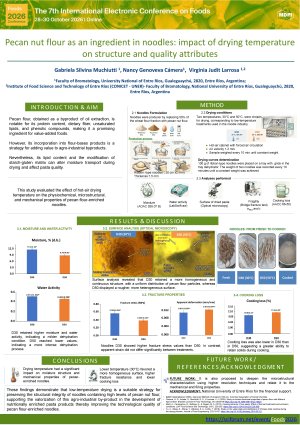
Pecan nut flour, rich in nutrients, is a promising ingredient for value-added foods; however, its incorporation may affect pasta drying behavior and product quality. This study evaluated the effect of hot-air drying temperature on the physicochemical, microstructural, and mechanical properties of pecan flour-enriched noodles. Noodles were produced by replacing 50% of the wheat flour fraction with pecan nut flour and dried under two conditions: D30 (30°C, 40 % RH) and D50 (50°C, 40 % RH). Moisture loss was monitored during drying, and final moisture content, water activity, microstructure, fracture properties, and cooking loss were determined. D30 exhibited a final moisture content of 11.6% and a water activity of 0.514, whereas D50 reached lower values (8.78% and 0.463, respectively), indicating a more intense dehydration process. Surface analysis revealed that D30 retained a more homogeneous and continuous structure, with a uniform distribution of pecan flour particles, whereas D50 displayed a rougher, more heterogeneous surface. These differences were confirmed by optical microscopy, which showed a more cohesive and compact matrix at 30°C, with no evidence of severe structural collapse, whereas samples D50 exhibited discontinuities, localized depressions, and reduced structural continuity associated with shrinkage phenomena and surface rigidification during drying. Mechanical properties reflected these microstructural changes. Noodles D30 showed significantly higher fracture stress values (0.569±0.043 MPa) than D50 (0.384±0.035 MPa), indicating greater mechanical resistance. In contrast, apparent strain did not differ significantly between treatments. Cooking loss was also lower in D30 (10.06±0.24%) than in D50 (11.58±0.03%), suggesting a greater ability to retain solids during cooking. These findings demonstrate that low-temperature drying is a suitable strategy for preserving the structural integrity of noodles containing high levels of pecan nut flour, supporting the valorization of this agro-industrial by-product in the development of nutritionally enriched pasta products thereby improving the technological quality of pecan flour-enriched noodles.
Keywords
Pecan nut flour
Drying
Microstructure
Fracture properties
Cooking quality.
Poster
Pecan nut flour as an ingredient in noodles_Larrosa.pdf
Bio-Prospecting and Probiotic Characterization of Lactic Acid Bacteria Isolated from Milk and Dahi of Indigenous Badri and Malnad Gidda Cattle of India
Antioxidant Capacity, Metabolite Profiles and In Silico Analysis of Purple Passion Fruit Peel Tea under Different Drying and Brewing Conditions