Event submissions
Published
This submission belongs to the session B. Nutritional & Functional Foods of the event The 7th International Electronic Conference on Foods
Published date
23 Oct, 2026
Academic Editor
 Manuel Viuda-Martos
Citation
Zheng Xin Toh, Mohamad Hafizi Abu Bakar, Feri Eko Hermanto, Ismail Ware, Zainul Amiruddin Zakaria, Mohamad Norisham Mohamad Rosdi, Antioxidant Capacity, Metabolite Profiles and In Silico Analysis of Purple Passion Fruit Peel Tea under Different Drying and Brewing Conditions, in Proceedings of The 7th International Electronic Conference on Foods, 28 October–30 October 2026, MDPI: Basel, Switzerland
Share
Email
Facebook
Twitter
LinkedIn
Antioxidant Capacity, Metabolite Profiles and In Silico Analysis of Purple Passion Fruit Peel Tea under Different Drying and Brewing Conditions

Zheng Xin Toh 1

Mohamad Hafizi Abu Bakar 2
Feri Eko Hermanto 3,4

Ismail Ware 5
Zainul Amiruddin Zakaria 6,7
Mohamad Norisham Mohamad Rosdi 8
1. Faculty of Food Science & Nutrition, Universiti Malaysia Sabah, 88400, Kota Kinabalu, Sabah, Malaysia
2. Bioprocess Technology Division, School of Industrial Technology, Universiti Sains Malaysia, 11800 Gelugor, Pulau Pinang, Malaysia
3. Department of Intelligent Livestock Industry, Faculty of Animal Science, Universitas Brawijaya, Malang, East Java 65145, Indonesia
4. Brawijaya Innovation Center for Genomics (BRAVOGEN), Universitas Brawijaya, Malang, East Java 65145, Indonesia
5. Biotechnology Research Institute, Universiti Malaysia Sabah, 88400 Kota Kinabalu, Sabah, Malaysia
6. Borneo Research on Algesia, Inflammation and Neurodegeneration (BRAIN) Group, Department of Biomedical Sciences, Faculty of Medicine and Health Sciences, Universiti Malaysia Sabah, 88400 Kota Kinabalu, Sabah, Malaysia
7. Department of Nutrition, Faculty of Health Sciences, Universitas Brawijaya, Puncak Dieng Eksklusif, Kunci, Kalisongo, Kecamatan Dau, Kabupaten Malang 65151, East Java, Indonesia
8. Nutrition in Community Engagement (NICE) Living Laboratory, Faculty of Food Science & Nutrition, Universiti Malaysia Sabah, 88400, Kota Kinabalu, Sabah, Malaysia
Abstract
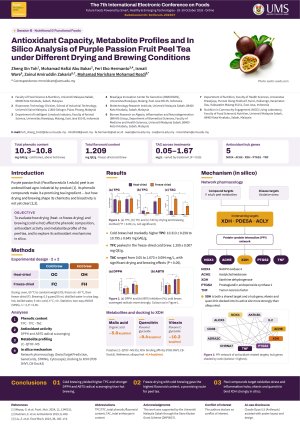
The peel of purple passion fruit (Passiflora edulis f. edulis) is an underutilised agro-industrial by-product that holds potential for valorisation as a tea ingredient because of its phenolic compounds.This study investigated the impact of various drying and brewing procedures on the phenolic composition, antioxidant activity, and metabolite profiles of purple passion fruit peel tea, while integrating network pharmacology, molecular docking, and molecular dynamics simulations to explore its potential bioactive mechanisms. Peel samples underwent specific drying processes (oven and freeze-drying) and brewing conditions (cold and hot brew). The findings indicated that both drying and brewing conditions substantially influenced TPC, TFC, TAC, antioxidant activity, and metabolite profiles of the peel tea. Cold-brewed samples demonstrated markedly elevated TPC values (10.313 ± 0.258 to 10.795 ± 0.645 mg GAE/g sample) in contrast to hot-brewed samples. TFC, conversely, had the highest value in the freeze-dried cold-brewed sample, measuring 1.209 ± 0.007 mg QE/g sample. In relation to TAC, notable impacts were detected between the drying and brewing processes (P<0.05), with findings varying from 0.409 ± 0.012 to 1.670 ± 0.094 mg/L. Both DPPH and ABTS assays demonstrated that cold-brewed samples exhibited greater free radical inhibition compared to hot-brewed samples. Metabolite profiling conducted via liquid chromatography–quadrupole time-of-flight mass spectrometry (LC–QTOF–MS) indicated the potential identification of malic acid, quercitrin, and vitexin. Three intersecting targets between P. edulis and oxidative stress were identified: XDH, PDE5A, and ACLY. The PPI network revealed the antioxidant-related molecular targets of P. edulis peel components, highlighting the five identified hub genes: NADPH oxidase 4 (NOX4), acetylcholinesterase (ACHE), xanthine dehydrogenase (XDH), prostaglandin-endoperoxidase synthase 2 (PTGS2), and tumor necrosis factor (TNF). These genes play critical roles in regulating oxidative stress and inflammatory responses. The findings underscore the significance of drying and brewing conditions in influencing the chemical composition and antioxidant qualities of purple passion fruit peel tea, offering insights on the utilisation of fruit peel by-products.
Keywords
Purple passion fruit peel
phenolic composition
anthocyanins
antioxidant activity
LC–QTOF–MS
network pharmacology
Poster
Foods 2026 poster · A1 portrait.pdf
PECAN NUT FLOUR AS AN INGREDIENT IN NOODLES: IMPACT OF DRYING TEMPERATURE ON STRUCTURE AND QUALITY ATTRIBUTE
Near-Infrared Spectroscopy and Chemometric Approaches for Discrimination of Brown and Milled Rice Based on Nutritional and Functional Properties