Event submissions
Published
This submission belongs to the session D. Food Microbiology & Biotechnologies of the event The 7th International Electronic Conference on Foods
Published date
23 Oct, 2026
Academic Editor
 Efstathios Giaouris
Citation
Emilia Janiszewska-Turak, Anna Dutkiewicz, Emilia Chołuj, Kamil Piwowarek, The Effect of Mono- and Co-Culture Fermentation on the Physicochemical Properties of Beetroot Juice, in Proceedings of The 7th International Electronic Conference on Foods, 28 October–30 October 2026, MDPI: Basel, Switzerland
Share
Email
Facebook
Twitter
LinkedIn
The Effect of Mono- and Co-Culture Fermentation on the Physicochemical Properties of Beetroot Juice

Emilia Janiszewska-Turak 1

Anna Dutkiewicz 2
Emilia Chołuj 2
Kamil Piwowarek 3
1. Department of Food Engineering, Institute of Food Sciences, Warsaw University of Life Sciences—SGGW, 159C Nowoursynowska St., 02-787 Warsaw, Poland
2. Faculty of Food Technology, Warsaw University of Life Sciences—SGGW, 159C Nowoursynowska St., 02-787 Warsaw, Poland
3. Department of Food Biotechnology and Microbiology, Institute of Food Sciences, Warsaw University of Life Sciences—SGGW, 159C Nowoursynowska St., 02-787 Warsaw, Poland
Abstract
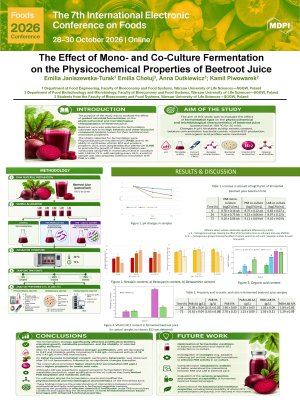
The purpose of the study was to evaluate the effect of guided microbial fermentation on the physicochemical and microbiological characteristics of beetroot juice (pasteurised at 100 ºC for 20 min/h). Beetroot juice was selected as the fermentation substrate due to its high content of betalains and other bioactive compounds, which are known for their nutritional and antioxidant properties. The strains selected for fermentation were Propionibacterium freudenreichii (PAB), due to its ability to synthesise vitamin B12 and produce propionic acid, and Lactiplantibacillus plantarum (LAB) to promote the growth of PAB. Fermentation was conducted using PAB in monoculture and in coculture with LAB for 72 h, with sampling every 24 h; a control sample, juice without inoculation with PAB or LAB, was also prepared. Changes in pH, titratable acidity, extract content, betalain concentration, bacterial counts, vitamin B12 production, and organic acid profiles were monitored.
The fermentation strategy significantly affected acidification kinetics, microbial growth, metabolite production, and the stability of selected quality attributes. After 72 h, the co-culture exhibited stronger acidification, with pH decreasing to 3.47 and titratable acidity increasing to 2.62 g/L, compared with pH 4.18 and 1.41 g/L in the PAB monoculture. An initial increase in betalain content, particularly betacyanin, was observed after 24 h of fermentation, followed by no significant changes thereafter. In contrast, the monoculture promoted higher vitamin B12 accumulation (65μg/L) and a higher propionic-to-acetic acid ratio. The increase in vitamin B12 concentration confirmed that beetroot juice provided suitable conditions for cobalamin biosynthesis by PAB. Although LAB was expected to support propionic fermentation through metabolite production, rapid acidification in the co-culture may have limited PAB adaptation and metabolic activity. Co-cultivation altered the fermentation course and modified the physicochemical and microbiological characteristics of the fermented juice. These findings improve understanding of interactions between propionic acid bacteria and lactic acid bacteria in fermented vegetable matrices, indicating the potential for effective vitamin B12 fortification under PAB monoculture conditions. Results support the development of novel fermented beetroot-based beverages with enhanced functional properties.
Keywords
Propionibacterium freudenreichii
Lactiplantibacillus plantarum
vitamin B12
propionic acid bacteria
betalains
co-culture fermentation
functional beverages
Poster
Foods poster template-EJT.pdf
Near-Infrared Spectroscopy and Chemometric Approaches for Discrimination of Brown and Milled Rice Based on Nutritional and Functional Properties
In Vitro Digestion of Pleurotus ostreatus Stem Flour and Extract: Release of Free Sugars and Organic Acids