Event submissions
Published
This submission belongs to the session B. Nutritional & Functional Foods of the event The 7th International Electronic Conference on Foods
Published date
23 Oct, 2026
Academic Editor
 Manuel Viuda-Martos
Citation
Pei Zhang, Piotr Koczoń, Bharani Kumar Palani, Cross-Continental Comparison of Chinese and European Producing Zones: Environmental Gradients of Nutritional Components in Naked Oats (Avena sativa L.), in Proceedings of The 7th International Electronic Conference on Foods, 28 October–30 October 2026, MDPI: Basel, Switzerland
Share
Email
Facebook
Twitter
LinkedIn
Cross-Continental Comparison of Chinese and European Producing Zones: Environmental Gradients of Nutritional Components in Naked Oats (Avena sativa L.)

Pei Zhang 1
Piotr Koczoń 2
Bharani Kumar Palani 2
1. College of Foreign Languages, Bohai University, Jinzhou, 121013, Liaoning, China
2. Department of Chemistry, Faculty of Food Sciences, Warsaw University of Life Sciences, Nowoursynowska 159 C, 02‑787 Warsaw, Poland
Abstract
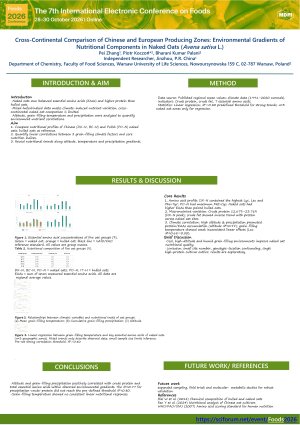
Naked oats feature well‑balanced essential amino acids (EAAs) and high protein content, making them a valuable cereal for human nutrition. Cross‑continental nutritional comparisons frequently combine hulled and naked oat genotypes, in which nutrient dilution originating from the fibrous husk can substantially mask climate‑driven nutritional variation in the edible kernel. In this study, we analysed published regional‑mean datasets from three representative naked‑oat producing zones: Dingxi (DX‑N) and Baicheng (BC‑N) in China, and Poland (PO‑N) (n = 3), representing three aggregated geographical points with contrasting climatic backgrounds. Hulled oat entries were included solely as an informative genotypic reference rather than a strict experimental control for environmental comparisons. Linear regression was applied to quantify the responses of crude protein, crude fat, and essential amino‑acid profiles to three key grain‑filling variables: altitude, mean grain‑filling temperature, and cumulative grain‑filling precipitation. A pre‑defined threshold of R² > 0.80 was adopted to define statistically robust fitted trends. Our results revealed that high‑altitude and wetter grain‑filling environments covaried positively with crude protein concentration and total EAA content, although not all pairwise relationships satisfied the strict fitting threshold. Among individual amino acids, leucine displayed a weak linear response to grain‑filling temperature, whereas lysine and the sum of methionine plus cysteine exhibited negligible correlation with the examined environmental predictors. Accordingly, no single dominant environmental driver could be reliably distinguished for kernel nutritional traits. Even after eliminating husk‑related dilution bias, cultivar‑driven genotypic effects remained partially confounded with environmental signals within the available dataset. Based on long‑term climatological normals, this cross‑continental analysis provides preliminary, practically oriented insights to support targeted high‑quality naked‑oat planting strategies across China and Europe, rather than definitive causal or mechanistic conclusions for oat grain nutrition.
Keywords
Oat (Avena sativa L.)
climatic factor
altitude
main nutrition quality
amino acids
Poster
Pei Zhang.pdf
In Vitro Digestion of Pleurotus ostreatus Stem Flour and Extract: Release of Free Sugars and Organic Acids
Effects of High hydrostatic pressure Treatment on the Flavor Quality of Kiwi Wine Based on Machine Learning and Flavoromics