Event submissions
Published
This submission belongs to the session C. Food Physicochemistry & Analysis of the event The 7th International Electronic Conference on Foods
Published date
23 Oct, 2026
Academic Editor
 Joana S. Amaral
Citation
Iwona Szymańska, Olga Redwańska, Aneta Cegiełka, Tomasz Florowski, Comparative Effects of Pea, Soy, and Wheat Protein Preparations on the Properties of Structured Emulsions, in Proceedings of The 7th International Electronic Conference on Foods, 28 October–30 October 2026, MDPI: Basel, Switzerland
Share
Email
Facebook
Twitter
LinkedIn
Comparative Effects of Pea, Soy, and Wheat Protein Preparations on the Properties of Structured Emulsions

Iwona Szymańska 1

Olga Redwańska 2
Aneta Cegiełka 1

Tomasz Florowski 1
1. Department of Food Technology and Assessment, Warsaw University of Life Sciences—SGGW, 159C Nowoursynowska Street, 02-776 Warsaw, Poland
2. Scientific Circle of Food Technologists, Warsaw University of Life Sciences—SGGW, 159C Nowoursynowska Street, 02-776 Warsaw, Poland
Abstract
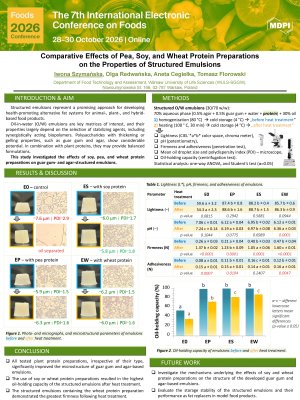
Structured emulsions are a promising strategy for developing health-oriented fat alternatives in animal-, plant-, and hybrid-based food systems. Oil-in-water (O/W) emulsions are key matrices whose properties depend on the selection of stabilizing agents, including synergistically acting biopolymers. Polysaccharides with thickening or gelling properties, such as guar gum and agar, have considerable potential, especially when combined with plant proteins. Therefore, this study investigated the effects of soy, pea, and wheat protein preparations on guar gum- and agar-structured emulsions.
Structured O/W emulsions (30/70 m/m) were produced by hot homogenization (~80 °C) followed by refrigerated storage (~4 °C). Samples were analyzed after preparation and primary stabilization, and after heat treatment (~100 °C) and secondary stabilization. Color (CIEL*a*b* system, reflectance method), pH (potentiometry), texture (penetration test), mean oil droplet size and polydispersity index (optical microscopy), and oil-holding capacity (centrifugation) were determined. Data were statistically analyzed using ANOVA and Student’s t-test.
The use of plant protein preparations, regardless of type, resulted in a significant increase in the L* color parameter and oil-holding capacity, and decreases in pH, mean oil droplet size, and polydispersity index, along with increases in firmness and adhesiveness of the structured emulsions, compared with the control sample. These changes indicate improved system homogeneity and more effective immobilization of the dispersed phase. Emulsions containing soy or wheat protein preparations exhibited the highest firmness in the primary state and the greatest oil-holding capacity in the secondary state, indicating enhanced structural stability. The mechanisms of action differed: soy proteins acted mainly through emulsifying properties, whereas wheat proteins contributed primarily via mechanical entrapment of oil within the gel network.
It was found that the type of plant protein preparation significantly affects the properties of structured emulsions. Unlike pea proteins, wheat proteins have the potential to serve as a technological alternative to soy proteins for emulsion structuring.
Keywords
structured emulsions
oil-in-water emulsions
guar gum
agar
plant proteins
emulsion stability
Poster
Poster Iwona Szymańska.pdf
Effects of High hydrostatic pressure Treatment on the Flavor Quality of Kiwi Wine Based on Machine Learning and Flavoromics
Effect of thermal pretreatment on the antioxidant capacity of Cymbopogon flexuosus essential oil when added to sunflower oil