Event submissions
Published
This submission belongs to the session C. Food Physicochemistry & Analysis of the event The 7th International Electronic Conference on Foods
Published date
23 Oct, 2026
Academic Editor
 Joana S. Amaral
Citation
Maria Paz Corradi, Nicolle Stefani Juncos, Carolina Cravero Ponso, Rubén Horacio Olmedo, Effect of thermal pretreatment on the antioxidant capacity of Cymbopogon flexuosus essential oil when added to sunflower oil, in Proceedings of The 7th International Electronic Conference on Foods, 28 October–30 October 2026, MDPI: Basel, Switzerland
Share
Email
Facebook
Twitter
LinkedIn
Effect of thermal pretreatment on the antioxidant capacity of Cymbopogon flexuosus essential oil when added to sunflower oil

Maria Paz Corradi 1
Nicolle Stefani Juncos 1
Carolina Cravero Ponso 2
Rubén Horacio Olmedo 3
1. Universidad Nacional de Córdoba. Facultad de Ciencias Agropecuarias. Laboratorio de Tecnología de Alimentos (LabTA)
CONICET. Instituto Multidisciplinario de Biología Vegetal (IMBIV), Córdoba, Argentina
2. Universidad Nacional de Córdoba. Facultad de Ciencias Agropecuarias. Laboratorio de Lactología/Producción de leche., Córdoba, Argentina
3. Universidad Nacional de Córdoba. Facultad de Ciencias Agropecuarias. Laboratorio de Tecnología de Alimentos (LabTA).
CONICET. Instituto de Ciencia y Tecnología de los Alimentos Córdoba (ICYTAC), Córdoba, Argentina
Abstract
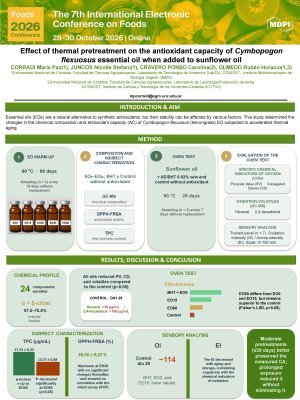
Essential oils (EOs) are a natural alternative to synthetic antioxidants, but their stability can be affected by various factors. This study determined the changes in the chemical composition and antioxidant capacity (AC) of Cymbopogon flexuosus (lemongrass) EO subjected to accelerated thermal aging. Aliquots of the EO were heated to 60 °C for 60 days, with samples (n = 3) collected on days 0, 15, 30, 45, and 60 (EO0–EO60). Each essential oil was characterized by GC-MS and evaluated using indirect assays (DPPH-FRSA, total phenolic content, TPC), and then incorporated (0.02% w/w) into sunflower oil stored at 60 °C for 28 days (oven test, n=3 per treatment), along with controls with and without BHT, while monitoring the peroxide value (PV), conjugated dienes (CD), volatiles (hexanal, 2,4-decadienal), and the intensity of oxidation and aroma using a trained sensory panel (n=7; OI/EI, 0–150 mm scale). Twenty-four components were identified; alpha- and beta-citral constituted the major fraction (67.5–75.8%). The TPC increased to EO45 (17.15 ± 0.32 μg/mL) and decreased significantly at EO60 (13.75 ± 0.68 μg/mL; Fisher’s LSD, p < 0.05); DPPH-FRSA increased up to EO30 (30.56 ± 0.32%) with no significant changes thereafter, and showed no correlation with the direct assay (ACP). In the oven test, all essential oils significantly reduced (p<0.05) PV, CD, and volatiles compared to the control, which exceeded 30 μg/mL of hexanal and 100 μg/mL of 2,4-decadienal on day 28. BHT and EO0 were the most effective, with no significant differences between them. Among the aged essential oils, EO15 performed best and EO60 worst, with significant differences compared to EO0 and EO15 (Fisher’s LSD test, p < 0.05), although EO60 remained significantly superior to the control. The control’s OI reached ~114 on day 28; BHT, EO0, and EO15 recorded the lowest values. The EI decreased with aging and storage, correlating negatively with the chemical indicators of oxidation. Moderate pretreatments (≤30 days) better preserved the measured CA; prolonged exposure reduced it without eliminating it.
Keywords
Lemongrass
Rancidity
Oxidation Volatiles
Poster
Corradi. Poster FOODS26.pdf
Comparative Effects of Pea, Soy, and Wheat Protein Preparations on the Properties of Structured Emulsions
Optimization of rye protein hydrolysis with Flavourzyme for the obtention of hydrolysates with radical scavenging properties