Event submissions
Published
This submission belongs to the session B. Nutritional & Functional Foods of the event The 7th International Electronic Conference on Foods
Published date
23 Oct, 2026
Academic Editor
 Manuel Viuda-Martos
Citation
Emmanuel Pérez-Escalante, Gabriela Mariana Rodríguez-Serrano, Luis Guillermo González-Olivares, Jesús Guadalupe Pérez-Flores, Laura García-Curiel, Elizabeth Contreras-López, Enrique J. Olloqui, Alexis Ayala-Niño, Optimization of rye protein hydrolysis with Flavourzyme for the obtention of hydrolysates with radical scavenging properties, in Proceedings of The 7th International Electronic Conference on Foods, 28 October–30 October 2026, MDPI: Basel, Switzerland
Share
Email
Facebook
Twitter
LinkedIn
Optimization of rye protein hydrolysis with Flavourzyme for the obtention of hydrolysates with radical scavenging properties

Emmanuel Pérez-Escalante 1,2
Gabriela Mariana Rodríguez-Serrano 2

Luis Guillermo González-Olivares 1

Jesús Guadalupe Pérez-Flores 1
Laura García-Curiel 3
Elizabeth Contreras-López 1
Enrique J. Olloqui 4
Alexis Ayala-Niño 5
1. Chemistry Department. Autonomous University of the State of Hidalgo. Mineral de la Reforma. 42184. Mexico.
2. Biotechnology Department. Metropolitan Autonomous University, Iztapalapa Campus. Mexico City. 09340. Mexico.
3. Nursing Department. Autonomous University of the State of Hidalgo. San Agustín Tlaxiaca. 42060. Mexico.
4. Agricultural and Animal Production Department. Metropolitan Autonomous University, Xochimilco Campus. Mexico City. 04960. Mexico.
5. Nutrition Department. Autonomous University of the State of Mexico, Professional Academic Unit. Acolman. 55875. Mexico.
Abstract
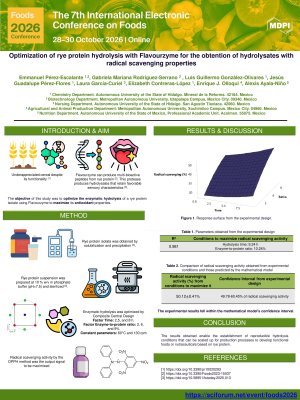
Rye is an underappreciated cereal, despite its high protein content and bioactive compounds, including polyphenols and arabinoxylans. It has been demonstrated that enzymatic hydrolysis of rye protein yields multifunctional hydrolysates with notable radical-scavenging activity and the ability to inhibit ACE and DPP-IV enzymes in vitro. Additionally, the commercial Aspergillus oryzae peptidase preparation known as Flavourzyme is recognized for producing bioactive hydrolysates without undesirable sensory attributes, making such hydrolysates suitable for the development of functional foods. Therefore, the objective of this study was to optimize the enzymatic hydrolysis of a rye protein isolate using Flavourzyme to maximize its antioxidant properties. The rye protein isolate was obtained using a solubilization-precipitation method, and the systems to be hydrolyzed were prepared at 10% (w/v) in phosphate buffer at pH 7.5 and sterilized prior to hydrolysis. A central composite design was used, in which the factors evaluated were hydrolysis time (2, 5, and 8 h) and the enzyme-to-protein ratio (3, 6, and 9%), with temperature and oscillatory agitation held constant at 60 °C and 130 rpm, respectively. Likewise, the output signal to be optimized was antioxidant capacity, measured using the DPPH assay. The optimization process yielded a model with a coefficient of determination (R²) of 0.981, with optimal conditions of a 10.24% enzyme-to-protein ratio and 9.24 h of hydrolysis, achieving an antioxidant activity of 50.12 ± 0.41%, which fell within the confidence interval of the predictive model. The results obtained allow for the establishment of reproducible hydrolysis conditions that can be scaled up to production processes for the development of functional foods or nutraceuticals based on rye protein.
Keywords
Rye protein
Antioxidant activity
Enzymatic hydrolysis
Response surface
Poster
Sciforum-196806.pdf
Effect of thermal pretreatment on the antioxidant capacity of Cymbopogon flexuosus essential oil when added to sunflower oil
Red Grape Pomace Flour: Exploring its Physicochemical composition, Antioxidant Characteristics and Technological Performance in Breadmaking