Event submissions
Published
This submission belongs to the session C. Food Physicochemistry & Analysis of the event The 7th International Electronic Conference on Foods
Published date
23 Oct, 2026
Academic Editor
 Joana S. Amaral
Citation
Mariana Soledad Lingua, Belén Pugh, Esperanza Mainez, Leticia Mir, Roxana Páez, Red Grape Pomace Flour: Exploring its Physicochemical composition, Antioxidant Characteristics and Technological Performance in Breadmaking, in Proceedings of The 7th International Electronic Conference on Foods, 28 October–30 October 2026, MDPI: Basel, Switzerland
Share
Email
Facebook
Twitter
LinkedIn
Red Grape Pomace Flour: Exploring its Physicochemical composition, Antioxidant Characteristics and Technological Performance in Breadmaking

Mariana Soledad Lingua 1
Belén Pugh 2
Esperanza Mainez 1
Leticia Mir 3
Roxana Páez 1
1. Dairy Chain Research Institute (IdICaL), National Institute of Agricultural Technology (INTA)/ National Council for Scientific and Technical Research (CONICET), Rafaela, S2300
2. National Institute of Agricultural Technology, (INTA), Trelew, U9100, Argentina
3. Industrial Quality and Value-Added Laboratory for Cereals and Oilseeds, Instituto National Institute of Agricultural Technology (INTA), Marcos Juárez, X2580
Abstract
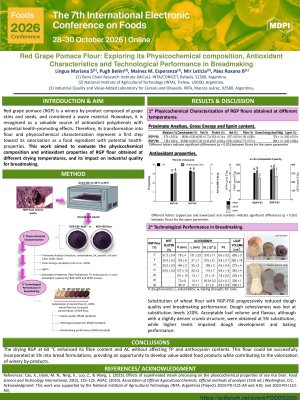
Red grape pomace (RGP), a winery by-product mainly composed of grape skins and seeds, has traditionally been considered a waste material with limited applications. Nowadays, it is recognized as a valuable source of antioxidant polyphenols with potential health-promoting effects. Therefore, its transformation into flour and physicochemical characterization represent a first step toward its valorization as a food ingredient with potential health-properties. The study evaluated the physicochemical composition and antioxidant properties of RGP flour obtained at different drying temperatures, and its impact on breadmaking performance. RGP was dried at 40 or 60 °C, ground, and sieved to obtain RGP-F40 and RGP-F60 flours. Both flours were characterized for physicochemical composition and antioxidant properties, including total polyphenols (TP), anthocyanins, and in vitro antioxidant capacity (AC; FRAP, ABTS, and DPPH assays). The technological performance of RGP flour was evaluated by replacing wheat flour at levels from 0 (control) to 30%. Gluten quality, rheological properties, and breadmaking performance were assessed and compared with control. Both flours showed similar protein contents (10.75%) and energy values (362 kcal/100g). However, RGP-F60 exhibited higher fibre (21.74%), lignin (9.45%), fat (7.27%), ash (10.5%), and moisture contents (7.6%), and lower carbohydrate levels (64%). RGP-F60 also showed greater AC determined by FRAP (214 µmol/g) and ABTS (454 µmol/g), whereas TP (35 mg/g), anthocyanins (3.9 mg/g), and DPPH (4.5 µmol/g) values were not affected by drying temperature. Substitution of wheat flour with RGP-F60 progressively reduced dough quality and breadmaking performance. Dough cohesiveness was lost at substitution levels ≥20%. Acceptable loaf volume and flavour, although with a slightly denser crumb structure, were obtained at 5% substitution, while higher levels impaired dough development and baking performance. Overall, drying RGP at 60 °C enhanced its fibre content and AC without affecting TP and anthocyanin contents. This flour could be successfully incorporated at 5% into bread formulations, providing an opportunity to develop value-added food products while contributing to the valorization of winery by-products.
Keywords
valorization
polyphenols
bread
chemical characterization
food ingredient
Poster
Lingua final 2026FEC .pdf
Optimization of rye protein hydrolysis with Flavourzyme for the obtention of hydrolysates with radical scavenging properties
Comparison of the Chemical Composition of Different Gluten-Free Brewer's Spent Grain Batches for Potential Applications in the Food Industry and Biorefineries