Event submissions
Published
This submission belongs to the session C. Food Physicochemistry & Analysis of the event The 7th International Electronic Conference on Foods
Published date
23 Oct, 2026
Academic Editor
 Joana S. Amaral
Citation
Ornela Bárbara L. Becker, Camila Goyenetche Brienzo, Analuz Acosta, María F. Laborde, Andrea N Pila, Eliana P. Dagnino, Ana M. Pagano, Verónica E. Capdevila, Mariana B. Laborde, Comparison of the Chemical Composition of Different Gluten-Free Brewer's Spent Grain Batches for Potential Applications in the Food Industry and Biorefineries, in Proceedings of The 7th International Electronic Conference on Foods, 28 October–30 October 2026, MDPI: Basel, Switzerland
Share
Email
Facebook
Twitter
LinkedIn
Comparison of the Chemical Composition of Different Gluten-Free Brewer's Spent Grain Batches for Potential Applications in the Food Industry and Biorefineries

Ornela Bárbara L. Becker 1
Camila Goyenetche Brienzo 1,2,3
Analuz Acosta 1
María F. Laborde 1
Andrea N Pila 4,5
Eliana P. Dagnino 5
Ana M. Pagano 1
Verónica E. Capdevila 1,3
Mariana B. Laborde 1,3
1. Department of Chemical Engineering and Food Technology, Tecnología de Semillas y Alimentos (TECSE), Faculty of Engineering, National University of the Center of Buenos Aires Province (UNCPBA), Olavarría B7400JWI, Argentina
2. National Scientific and Technical Research Council (CONICET), CONICET, Tandi B7000GHG, Argentina
3. Center for Research in Physics and Engineering of the Center of Buenos Aires Province (CIFICEN), National University of the Center of Buenos Aires Province (UNCPBA) – Scientific Research Commission of Buenos Aires Province (CICPBA) – National Scientific and Technical Research Council (CONICET), Olavarría B7400JWI, Argentina
4. Institute for Modeling and Technological Innovation (IMIT), National Scientific and Technical Research Council (CONICET) – National University of the Northeast (UNNE), Corrientes W3404AAS, Argentina
5. UTN Research Group in Biological Organic Chemistry (QUIMOBI), Facultad Regional Resistencia (FRRe), National Technological University (UTN), Resistencia H3500CHI, Argentina
Abstract
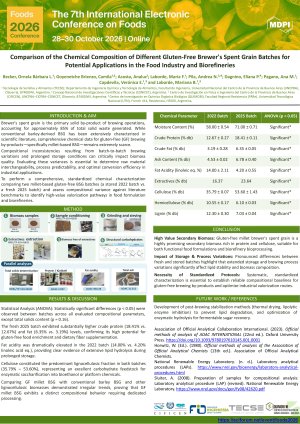
Brewer’s spent grain (BSG) is the main by-product generated during brewing. Information on the chemical composition of gluten-free BSG remains scarce. This study compared two millet-based gluten-free BSG batches and values reported in the literature to determine compositional differences affecting interchangeability and valorization potential. Samples were characterized using standardized (NREL-AOAC-AOCS) methods. Data were analyzed by ANOVA and Tukey’s test (p < 0.05). Results are reported on a dry basis, except moisture content.
Significant differences (p<0.05) were observed between batches for all parameters evaluated, except total solids content (p=0.16). For the 2022 batch, moisture, fat, protein, ash, fat acidity (expressed as linoleic acid equivalents), and extractives contents were 58.00 ± 0.54 % ; 3.19 ± 0.28 %; 12.67 ± 0.27 %; 4.53 ± 0.02 %; 14.00 ± 2.11 % and 16.37 %, respectively. The corresponding values for the 2025 batch were 71.00 ± 0.71 %; 6.35 ± 0.05 %; 18.41 ± 0.11 %; 6.78 ± 0.40 %; 4.20 ± 0.55 % and 23.64 %, respectively. The lignocellulosic fraction of both batches consisted of cellulose (35.79 ± 0.07 % – 53.60 ± 1.43 %), hemicellulose (10.55 ± 0.17 % – 6.10 ± 0.03 %) and lignin (12.30 ± 0.30 % – 7.03 ± 0.04 %).
Differences in chemical composition were observed between the 2022 stored batch and the recently produced 2025 batch. Although the causes were not investigated, they may be associated with prolonged storage and batch-to-batch process variations. Comparison with conventional BSG and other lignocellulosic biomasses showed no consistent pattern, with some compositional parameters being comparable and others differing. These findings highlight the need for standardized characterization of gluten-free BSG to generate comparable datasets and support its valorization in food and biorefinery applications.
Keywords
brewer's spent grain
gluten-free
lignocellulosic biomass
food valorization
biorefinery
Poster
Foods2026-Becker-Goyenetche et all.pdf
Red Grape Pomace Flour: Exploring its Physicochemical composition, Antioxidant Characteristics and Technological Performance in Breadmaking
Fruit peel powders as functional ingredients to improve antioxidant- properties of Kombucha-like beverages