Event submissions
Published
This submission belongs to the session B. Nutritional & Functional Foods of the event The 7th International Electronic Conference on Foods
Published date
23 Oct, 2026
Academic Editor
 Manuel Viuda-Martos
Citation
Lucía Alvarez-Antuña, Jessica Natalie Báez, Victoria Olt, Matías Rodríguez-Elhordoy, Alejandra Medrano, Adriana Maite Fernández-Fernández, Brown onion peel as a functional ingredient: antioxidant and anti-inflammatory potential after in vitro digestion, in Proceedings of The 7th International Electronic Conference on Foods, 28 October–30 October 2026, MDPI: Basel, Switzerland
Share
Email
Facebook
Twitter
LinkedIn
Brown onion peel as a functional ingredient: antioxidant and anti-inflammatory potential after in vitro digestion

Lucía Alvarez-Antuña 1

Jessica Natalie Báez 1
Victoria Olt 1

Matías Rodríguez-Elhordoy 1

Alejandra Medrano 1

Adriana Maite Fernández-Fernández 1
1. Laboratorio de Bioactividad y Nanotecnología de Alimentos, Área Química de Alimentos, Departamento de Ciencia y Tecnología de los Alimentos, Facultad Química, Universidad de la República (UdelaR), 11800 Montevideo, Uruguay
Abstract
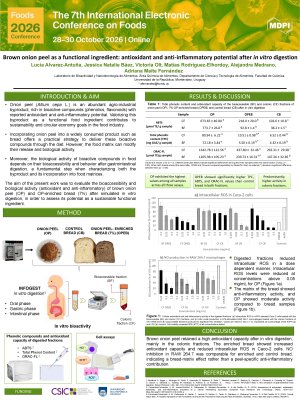
Onion peel is an abundant byproduct of the food industry with high content of bioactive compounds, so its valorization is of interest. In this work, the objective was to evaluate the bioaccessibility and the biological activity of breads supplemented with 7% of brown onion peel (BOP). BOP and breads (with and without the byproduct) were subjected to in vitro simulation of digestion by INFOGEST protocol, obtaining after centrifugation the bioaccessible (supernatant) and colonic (precipitate) fractions (BF and CF, respectively). BF and CF antioxidant capacity was evaluated by total phenolic content (TPC, Folin reaction) and ABTS assays. Intracellular antioxidant activity was performed by measuring reactive oxygen species (ROS) in intestinal Caco-2 cells and anti-inflammatory activity by inhibition of NO production in RAW264.7 macrophages.
BOP BF and CF exhibited high TPC (72.2 and 56.7 mgGAE/g) and ABTS [656.9 and 472.1 µmol Trolox equivalents (TE)/g] values, respectively. Regarding onion peel-enriched bread (OPEB), BF and CF showed higher TPC compared to the control bread (5.5 and 3.7 mgGAE/g, respectively, p<0.05). Similarly, ABTS values were higher for OPEB (102.9 and 270.1 µmolTE/g in the respective fractions, p<0.05). Cell assays were performed with concentrations of BF and CF up to 0.5 mg/mL of BOP and OPEB as no cytotoxicity was shown by MTT. Intracellular ROS levels were reduced at concentrations above 0.05 mg/mL for BOP fractions compared to AAPH control (p<0.05). In the same line, OPEB showed inhibition of intracellular ROS levels compared to the AAPH control, whereas control bread showed no inhibition. Furthermore, the BF and CF of BOP and breads inhibited the production of nitric oxide when compared to LPS control (p<0.05).
In conclusion, OPEB exhibited enhanced antioxidant properties and showed potential biological activity after in vitro digestion, highlighting its potential as an ingredient for the development of sustainable functional foods.
Keywords
sustainable food systems
agri-food industry byproducts
onion peel
functional foods
health-promoting properties
Poster
Poster foods onion peel L. Alvarez.pdf
Phenolic-Enriched Extracts from Lulo (Solanum quitoense) Obtained by Flash Vacuum Expansion and Incorporated into Whey Protein Concentrate Hydrogels
Probiotic-derived extracellular vesicles: Emerging natural inhibitors of foodborne pathogens and biofilms