Event submissions
Published
This submission belongs to the session B. Nutritional & Functional Foods of the event The 7th International Electronic Conference on Foods
Published date
23 Oct, 2026
Academic Editor
 Manuel Viuda-Martos
Citation
Jollan Alleyn Gungon, Jann Patrick Jusi, Luigi Mercado, Francine Kate Mangubat, Rai Astrid Urbina, Erwin Limbo Descallar, Vitamin Composition of Fresh Young Banaba (Lagerstroemia speciosa) and Malunggay (Moringa oleifera) Leaves: A Comparative Evaluation, in Proceedings of The 7th International Electronic Conference on Foods, 28 October–30 October 2026, MDPI: Basel, Switzerland
Share
Email
Facebook
Twitter
LinkedIn
Vitamin Composition of Fresh Young Banaba (Lagerstroemia speciosa) and Malunggay (Moringa oleifera) Leaves: A Comparative Evaluation

Jollan Alleyn Gungon 1
Jann Patrick Jusi 1
Luigi Mercado 1
Francine Kate Mangubat 1
Rai Astrid Urbina 1
Erwin Limbo Descallar 2
1. Department of Nutrition and Dietetics, Polytechnic University of the Philippines, Manila 1016, Philippines
2. Department of Food Technology, Polytechnic University of the Philippines, Manila 1016, Philippines
Abstract
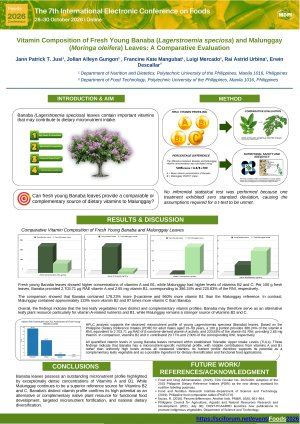
Fresh young Banaba (Lagerstroemia speciosa) leaves may serve as a potential source of dietary micronutrients due to their reported vitamin content. This study compared the vitamin composition (e.g A, C, B1, and B2) of fresh young Banaba leaves with that of fresh malunggay (Moringa oleifera) leaves, a commonly consumed leafy vegetable recognized for its nutritional value. Vitamin concentrations of Banaba leaves previously quantified using High-Performance Liquid Chromatography (HPLC) were evaluated and compared with reference values for malunggay from the Philippine Food Composition Tables (PhilFCT). Nutrient adequacy and safety assessments were conducted using the Philippine Dietary Reference Intakes (PDRI) and established Tolerable Upper Intake Levels. Results showed that 100 g of fresh young Banaba leaves provided more than 100% of the Recommended Nutrient Intake (RNI) for vitamins A and B1. Vitamin B2 contributed 20.77–24.55% of the RNI, while vitamin C contributed only 2.00–2.33%. Comparative analysis indicated that Banaba leaves contained substantially higher levels of vitamins A and B1 than malunggay. In contrast, malunggay had higher concentrations of vitamins B2 and C. Safety assessment showed that the measured vitamin levels in Banaba leaves remained below established upper intake limits. These findings demonstrate distinct differences in the vitamin profiles of Banaba and malunggay leaves. While malunggay remains a richer source of vitamins B2 and C, Banaba leaves exhibit higher concentrations of vitamins A and B1, highlighting their potential as an alternative leafy plant resource for functional food development and dietary diversification.
Keywords
Banaba Leaves
Moringa
Nutritional Analysis
Functional food
Poster
Banaba Poster Mats.pdf
Tracking one year of homemade kombucha backslopping: microbial succession, chemical transformations and bioactivity in green and black tea fermentations
Development and Validation of a TaqMan Real-Time PCR Assay for Species-Level Authentication of Locusta migratoria in Commercial Food and Feed Matrices