Event submissions
Published
This submission belongs to the session D. Food Microbiology & Biotechnologies of the event The 7th International Electronic Conference on Foods
Published date
23 Oct, 2026
Academic Editor
 Efstathios Giaouris
Citation
Vânia Rodrigues, Dora Henriques, M. Alice Pinto, Joana S. Amaral, Development and Validation of a TaqMan Real-Time PCR Assay for Species-Level Authentication of Locusta migratoria in Commercial Food and Feed Matrices, in Proceedings of The 7th International Electronic Conference on Foods, 28 October–30 October 2026, MDPI: Basel, Switzerland
Share
Email
Facebook
Twitter
LinkedIn
Development and Validation of a TaqMan Real-Time PCR Assay for Species-Level Authentication of Locusta migratoria in Commercial Food and Feed Matrices

Vânia Rodrigues 1

Dora Henriques 1

M. Alice Pinto 1

Joana S. Amaral 1
1. CIMO, LA SusTEC, Instituto Politécnico de Bragança, Bragança, Portugal
Abstract
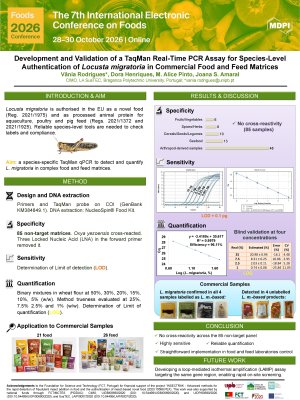
Locusta migratoria (Orthoptera: Acrididae) is one the insect species authorised in the European Union for food and feed applications, including as a novel food under Regulation (EU) 2021/1975, and as a processed animal protein (PAP) for aquaculture, poultry, and pig feed under Regulations (EU) 2021/1372 and 2021/1925. Given its nutritional value and growing relevance in the edible insect and feed sectors, reliable species-level authentication tools are needed to ensure correct labelling and regulatory compliance.
In this work, a species-specific TaqMan real-time PCR assay targeting the mitochondrial cytochrome c oxidase subunit I (COI) gene of L. migratoria (GenBank: KM384849.1) was developed and validated for its detection and quantification in complex food and feed matrices. Specific primers and TaqMan probe were designed, and DNA was extracted using the NucleoSpin® Food Kit. Although in silico analysis revealed no cross-reactivity, non-specific amplification was observed for Oxya yezoensis during cross-reactivity testing. To address this challenge, three Locked Nucleic Acid (LNA) modifications were incorporated into the forward primer, successfully eliminating this cross-reactivity. Specificity was confirmed against 86 non-target matrices, including 49 insect species, 13 seafood species, 10 cereals/seeds/legumes, 8 spices/herbs, and 6 fruits/vegetables matrices, with no false-positive amplification. The LOD was 0.0001 ng of L. migratoria genomic DNA. A calibration curve constructed from binary mixtures of L. migratoria flour in wheat flour at 50%, 30%, 20%, 15%, 10% and 5% w/w yielded a PCR efficiency of 96.11%, R2 of 0.998, and LOQ of 1% (w/w). Method trueness, evaluated at four concentration levels, 25%, 7.5% 2.5% and 1% (w/w), yielded percentage errors ranging from -26.22 to 10.78% and coefficients of variation below 0.54%.
The validated assay was applied to 47 commercial insect-labelled products, confirming L. migratoria DNA in four products, declaring this species and detecting it in four unlabelled products (33.83<Cq<38.15), indicating potential cross-contamination or mislabelling. Overall, this assay provides a sensitive and specific tool for L. migratoria authentication in food and feed products
Keywords
Locusta migratoria
real-time PCR
species authentication
edible insects
food fraud
novel food
Poster
sciforum-197902 Vânia Rodrigues Foods Poster_VR.pdf
Vitamin Composition of Fresh Young Banaba (Lagerstroemia speciosa) and Malunggay (Moringa oleifera) Leaves: A Comparative Evaluation
Dielectric characterization of foods in solid and semi-solid state