Event submissions
Published
This submission belongs to the session D. Food Microbiology & Biotechnologies of the event The 7th International Electronic Conference on Foods
Published date
23 Oct, 2026
Academic Editor
 Efstathios Giaouris
Citation
Virginia Melany Lara, Lorena Inés Brugnoni, María Fernanda Gliemmo, Carmen Adriana Campos, Disruption of Candida tropicalis biofilms on stainless steel by essential oil emulsions, in Proceedings of The 7th International Electronic Conference on Foods, 28 October–30 October 2026, MDPI: Basel, Switzerland
Share
Email
Facebook
Twitter
LinkedIn
Disruption of Candida tropicalis biofilms on stainless steel by essential oil emulsions

Virginia Melany Lara 1
Lorena Inés Brugnoni 2,3
María Fernanda Gliemmo 1,4
Carmen Adriana Campos 1,4
1. Department of Industry, Faculty of Exact and Natural Sciences, Universidad de Buenos Aires, University City, Buenos Aires, Argentina
2. Institute of Biological and Biomedical Sciences of the South (INBIOSUR, UNS–CONICET), (INBIOSUR, UNS–CONICET), Bahía Blanca, Buenos Aires, Argentina
3. Department of Biology, Biochemistry and Pharmacy, Universidad Nacional del Sur (UNS), Bahía Blanca, Buenos Aires, Argentina
4. Institute of Food Technology and Chemical Processes (ITAPROQ), CONICET–Universidad de Buenos Aires, University City, Buenos Aires, Argentina
Abstract
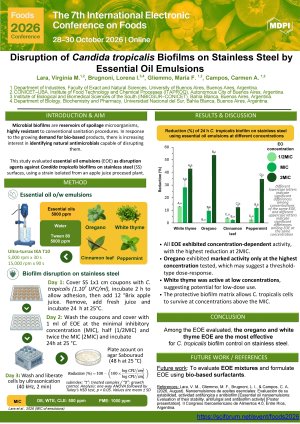
Microbial biofilms are reservoirs of spoilage microorganisms highly resistant to conventional sanitation procedures. This study evaluated essential oil emulsions (EOE) as disruption agents against Candida tropicalis biofilms on stainless steel (SS) surfaces, using a strain isolated from an apple juice industry. Emulsions of oregano (OE), cinnamon leaf (CLE), peppermint (PME), and white thyme (WTE) essential oils were prepared with Tween 80 as an emulsifier, using a high-speed homogenizer. Disruption capability was assessed at the minimal inhibitory concentration (MIC: WTE, CLE, OE: 500 ppm and PME: 1000 ppm), half the MIC (½MIC), and twice the MIC (2MIC), determined in a previous study. Biofilms were developed on SS coupons for 24h at 25°C using an inoculum of 1×10⁶ CFU/mL and apple juice as a nutrient medium, yielding a control of 6.8 logCFU/cm² viable cells. After treatment, coupons were rinsed with peptone water and sonicated at 40kHz for 2min to detach cells. Viable cells were enumerated on Sabouraud Dextrose Agar and the percentage reduction (%Reduction) was determined. Statistical analysis was performed using ANOVA followed by Tukey's test. At ½MIC, reductions were limited: 13.2 ± 0.2% (WTE), 4.1 ± 0.3% (CLE), and negligible reductions for OE and PME. At MIC, reductions reached 29.3 ± 5.1% (WTE), 11.0 ± 1.1% (PME), 10.0 ± 2.2% (OE), and 2.4 ± 0.2% (CLE). At 2MIC, the highest reductions were recorded: 53.9 ± 2.1% (OE), 42.4 ± 1.8% (WTE), 34.8 ± 2.1% (PME), and 12.5 ± 1.3% (CLE). All EOE exhibited concentration-dependent activity, with OE and WTE showing the greatest efficacy at 2MIC. No complete biofilm eradication was achieved, reflecting the resistance of biofilms. These findings support OE and WTE as candidates for biofilm control.
Keywords
candida tropicalis
biofilm
stainless steel
essential oil
emulsion
disruption
Poster
Lara Foods poster.pdf
Dielectric characterization of foods in solid and semi-solid state
Influence of Olive Tree Age and Interannual Variability on Nutritional and Health-Related Compounds in Verdeal Transmontana Olive Oils