Event submissions
Published
This submission belongs to the session B. Nutritional & Functional Foods of the event The 7th International Electronic Conference on Foods
Published date
23 Oct, 2026
Academic Editor
 Manuel Viuda-Martos
Citation
Sandra Lamas, Susana Casal, Rebeca Cruz, Paula Baptista, Nuno Rodrigues, Influence of Olive Tree Age and Interannual Variability on Nutritional and Health-Related Compounds in Verdeal Transmontana Olive Oils, in Proceedings of The 7th International Electronic Conference on Foods, 28 October–30 October 2026, MDPI: Basel, Switzerland
Share
Email
Facebook
Twitter
LinkedIn
Influence of Olive Tree Age and Interannual Variability on Nutritional and Health-Related Compounds in Verdeal Transmontana Olive Oils

Sandra Lamas 1

Susana Casal 2

Rebeca Cruz 2

Paula Baptista 1

Nuno Rodrigues 1
1. CIMO, LA SusTEC, Instituto Politécnico de Bragança, Campus de Santa Apolónia, 5300-253 Bragança, Portugal.
2. LAQV/REQUIMTE, Universidade do Porto, Faculdade de Farmácia, Rua de Jorge Viterbo Ferreira, 228, Porto, 4050-313, Portugal.
Abstract
Introduction: Olive oil composition is influenced by cultivar, environmental conditions, agronomic practices, and fruit maturity. Although olive trees undergo marked physiological changes throughout their lifespan, the effect of tree age on olive oil quality remains poorly understood. This study evaluated the influence of tree age on the chemical composition and bioactive properties of olive oils from the Portuguese cultivar Verdeal Transmontana.
Material and methods: Olive oils were obtained from three age groups of olive trees: young (≤25 years), middle-aged (≤50 years), and centenarian (≥100 years), all grown under the same agronomic and environmental conditions in Mirandela (northern Portugal). Sampling was carried out over four consecutive crop years (2022-2025). Olive oils were analyzed for physicochemical quality parameters, antioxidant activity, oxidative stability, fatty acid composition, tocopherol profile, and hydroxytyrosol and tyrosol derivatives. Data were evaluated using two-way ANOVA, followed by Tukey’s HSD test. PCA and LDA were applied to explore sample discrimination according to tree age and crop year.
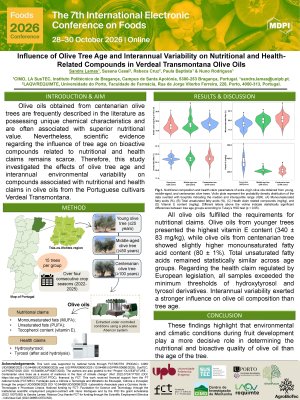
Results: All samples complied the legal standards for extra virgin olive oil. Although significant differences were found among tree age groups, crop year had a stronger influence on most parameters. Oils from centenarian trees exhibited higher oleic acid (80.0 %), lower polyunsaturated fatty acids (3.1 %), and higher total phenolic compounds, including hydroxytyrosol derived, contributing to enhanced oxidative stability and bioactivity. In contrast, oils from younger trees showed higher polyunsaturated fatty acids (5.5 %) and tocopherol (459 mg/kg). PCA clear separated samples, mainly according to antioxidant activity, oxidative stability, tocopherols, and phenolic compounds, while LDA confirmed the discriminatory effect of tree age.
Conclusion: Olive tree age influenced the composition of cv. Verdeal Transmontana oils, but interannual variability had a greater overall impact, highlighting the predominant role of environmental conditions in olive oil quality.
Keywords
Nutritional functional properties
Fatty acid composition
Tocopherols.
Poster
Foods poster_Sandra Lamas.pdf
Disruption of Candida tropicalis biofilms on stainless steel by essential oil emulsions
Sustainable Processing of Citrus By-Products: Influence of Drying on Bioactive Compound Recovery