Event submissions
Published
This submission belongs to the session C. Food Physicochemistry & Analysis of the event The 7th International Electronic Conference on Foods
Published date
23 Oct, 2026
Academic Editor
 Joana S. Amaral
Citation
Ena Habuš, Antonia Klarić, Maja Benković, Tamara Jurina, Davor Valinger, Ana Jurinjak Tušek, Jasenka Gajdoš Kljusurić, Sustainable Processing of Citrus By-Products: Influence of Drying on Bioactive Compound Recovery, in Proceedings of The 7th International Electronic Conference on Foods, 28 October–30 October 2026, MDPI: Basel, Switzerland
Share
Email
Facebook
Twitter
LinkedIn
Sustainable Processing of Citrus By-Products: Influence of Drying on Bioactive Compound Recovery

Ena Habuš 1
Antonia Klarić 1

Maja Benković 1
Tamara Jurina 1

Davor Valinger 1

Ana Jurinjak Tušek 1

Jasenka Gajdoš Kljusurić 1
1. Faculty of Food Technology and Biotechnology, University of Zagreb, Pierottijeva 6, 10000 Zagreb, Croatia
Abstract
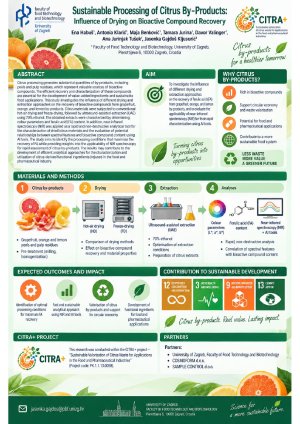
Citrus processing generates substantial quantities of by-products, including peels and pulp residues, which represent valuable sources of bioactive compounds. The efficient recovery and characterization of these compounds are essential for the development of value-added ingredients and sustainable food applications. This study investigates the influence of different drying and extraction approaches on the recovery of bioactive compounds from grapefruit, orange, and lemon by-products. Citrus materials were subjected to conventional hot-air drying and freeze-drying, followed by ultrasound-assisted extraction (UAE) by use of 70% ethanol. The obtained extracts were characterized by determining colour parameters and ferulic acid (FA) content. Ferulic acid is a powerful antioxidant because it neutralizes the damage caused. In addition, near-infrared spectroscopy (NIR) was applied as a rapid and non-destructive analytical tool for the characterization of dried citrus materials and the evaluation of potential relationships between spectral features and bioactive compound content. The study aims to identify the processing conditions that maximize the recovery of FA while providing insights into the applicability of NIR spectroscopy for rapid assessment of citrus by-products using AI tools. The results may contribute to the development of efficient analytical approaches for the characterization and utilization of citrus-derived functional ingredients (re)used in the food and pharmaceutical industry.
Keywords
citrus by-products
ferulic acid
NIR spectroscopy
UAE
Poster
Poster Foods_2026.pdf
Influence of Olive Tree Age and Interannual Variability on Nutritional and Health-Related Compounds in Verdeal Transmontana Olive Oils
Hurdle technologies for the preservation of nixtamalized tortillas: application of sous vide processing and refrigerated storage