Event submissions
Published
This submission belongs to the session B. Nutritional & Functional Foods of the event The 7th International Electronic Conference on Foods
Published date
23 Oct, 2026
Academic Editor
 Manuel Viuda-Martos
Citation
Romina Bodoira, Carolina Aranibar, Mariela Cecilia Bustos, Marcela Martínez, Damián Maestri, Pablo Daniel Ribotta, Effect of Thermomechanical Extrusion on the Antioxidant Activity of Peanut Skin: An Exploratory Study, in Proceedings of The 7th International Electronic Conference on Foods, 28 October–30 October 2026, MDPI: Basel, Switzerland
Share
Email
Facebook
Twitter
LinkedIn
Effect of Thermomechanical Extrusion on the Antioxidant Activity of Peanut Skin: An Exploratory Study

Romina Bodoira 1
Carolina Aranibar 1
Mariela Cecilia Bustos 1
Marcela Martínez 2,3
Damián Maestri 2,3

Pablo Daniel Ribotta 1
1. Instituto de Ciencia y Tecnología de los Alimentos Córdoba (ICYTAC). Consejo de Investigaciones Científicas y Técnicas (CONICET). Universidad Nacional de Córdoba (UNC)., Córdoba, Argentina
2. Facultad de Ciencias Exactas, Físicas y Naturales - Universidad Nacional de Córdoba, Córdoba , Argentina
3. Instituto Multidisciplinario de Biología Vegetal (IMBIV - CONICET - UNC), Córdoba, Argentina
Abstract
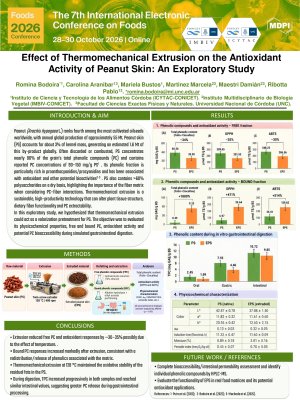
Peanuts ranks fourth among the most cultivated oilseeds worldwide, with an annual global production of 55 Mt. Given that peanut skin (PS) accounts for about 3% of the grain’s gross weight, global processing generates an estimated 1.6 Mt of this by-product. Frequently discarded or combusted, PS concentrates nearly 90% of the grain’s total phenolics compounds (PCs) (90–150 mg/g), positioning them as a promising source of bioactive compounds. Thermomechanical extrusion is a sustainable technology that has been widely used to improve the nutritional and functional properties of agro-industrial by-products.
The aim of this study was to evaluate the effect of extrusion on the antioxidant activity (AA) of PS for the development of a functional ingredient. PS was processed in a co-rotating twin-screw extruder (128°C, 400 rpm). The resulting extruded peanut skin (EPS) was dried and milled. After cold defatting, free PCs were extracted from both (PS and EPS) by hydroalcoholic maceration (70%-ethanol). Bound PCs were subsequently recovered from the extraction residue by alkaline hydrolysis followed by ethyl-acetate partitioning. Total phenolic content and AA were determined using the Folin–Ciocalteu, DPPH and ABTS assays.
Extrusion reduced free PCs and AA by approximately 30–34% in EPS compared with PS. However, bound PCs increased from 0.5 to 9.3 mg gallic acid equivalents (GAE)/g sample and AA from 6.9 to 35.6 μmol Trolox equivalents/g sample in PS and EPS, respectively. These results indicate that extrusion retains nearly 70% of the free PCs while promoting structural changes—such as the release of bound phenolics from the matrix—that could plausibly influence their bioavailability, although this aspect was not assessed in the present study and warrants further investigation. Overall, extrusion represents a strategy for the valorization of PS, generating a functional ingredient with potential antioxidant applications in the food industry, thus promoting the circular economy.
Keywords
peanut skin
extrusion
phenolics compounds
Poster
Foods poster final.pdf
Hurdle technologies for the preservation of nixtamalized tortillas: application of sous vide processing and refrigerated storage
Chemometric Mapping of Phenolic Diversity in Lamiaceae Extracts Highlights Solvent-Dependent Patterns