Event submissions
Published
This submission belongs to the session C. Food Physicochemistry & Analysis of the event The 7th International Electronic Conference on Foods
Published date
23 Oct, 2026
Academic Editor
 Joana S. Amaral
Citation
Kacper Kut, Grzegorz Bartosz, Izabela Sadowska-Bartosz, Effect of Metal Ion Complexation on the Stability and Antioxidant Properties of Anthocyanins, in Proceedings of The 7th International Electronic Conference on Foods, 28 October–30 October 2026, MDPI: Basel, Switzerland
Share
Email
Facebook
Twitter
LinkedIn
Effect of Metal Ion Complexation on the Stability and Antioxidant Properties of Anthocyanins

Kacper Kut 1
Grzegorz Bartosz 1

Izabela Sadowska-Bartosz 1
1. Laboratory of Analytical Biochemistry, Institute of Food Technology and Nutrition, Faculty of Technology and Life Sciences, University of Rzeszow, 35-959 Rzeszów, Poland
Abstract
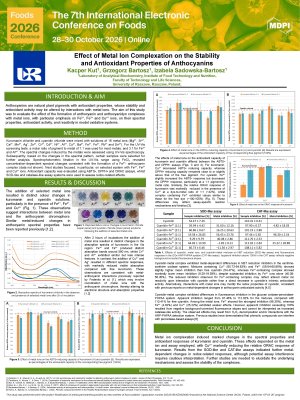
Introduction: Anthocyanins are natural plant pigments with antioxidant properties, whose stability and antioxidant activity may be altered by interactions with metal ions. The aim of this study was to evaluate the effect of the formation of anthocyanin complexes with metal ions, with particular emphasis on Fe²⁺, Fe³⁺ and Cu²⁺ ions, on their spectral properties, antioxidant activity, and reactivity in model oxidative systems.
Methods: The formation of anthocyanin–metal complexes was analyzed using UV–Vis spectroscopy. The model compounds were kuromanin chloride and cyanidin chloride, and the studies focused, in particular, on complexes with Fe³⁺, Fe²⁺ and Cu²⁺ ions.
Results and Discussion: The absorption spectra showed changes in the spectral properties of anthocyanins in the presence of iron and copper ions, indicating their interaction with the anthocyanin chromophore. Antioxidant properties of anthocyanins and their metal complexes evaluated by reduction of the ABTS• and DPPH• radicals and ORAC assay which measures the protection of fluorescein against AAPH-induced oxidation. The formation of complexes did not result in a uniform increase or decrease in antioxidant activity relative to free anthocyanins. Instead, the observed effects depended on the metal ion and the mechanism of the assay used. Anthocyanin complexes with Fe and Cu ions may exhibit pseudoenzymatic SOD-like and catalase-like activity or limit the involvement of metals in pro-oxidative reactions.
Conclusions: The results obtained indicate that the complexation of Fe²⁺, Fe³⁺ and Cu²⁺ ions has an effect on the spectral, antioxidant, and redox properties of anthocyanins, and the varied nature of the observed changes suggests that further research into the mechanism of these interactions is warranted.
This study was performed within the project “Modification of anthocyanins/anthocyanidins as new markers of food oxidation” (application number 2023/51/B/NZ9/02490) financed by the National Science Center (NCN), Poland, within the “OPUS 26” program.
Keywords
cyanidin
kuromanin
metal ion
antioxidant properties
Poster
Effect of Metal Ion Complexation on the Stability and Antioxidant Properties of Anthocyanins.pdf
INSIGHT INTO THE CHEMICAL AND FUNCTIONAL PROPERTIES OF ARTICHOKE LEAVES
Natural Deep Eutectic Solvents for Enhanced Extraction of Chicoric Acid from Chicory (Cichorium intybus L.) Herb