Event submissions
Published
This submission belongs to the session C. Food Physicochemistry & Analysis of the event The 7th International Electronic Conference on Foods
Published date
23 Oct, 2026
Academic Editor
 Joana S. Amaral
Citation
Małgorzata Rak, Grzegorz Bartosz, Izabela Sadowska-Bartosz, Anthocyanin fluorescence for monitoring oxidation of the chokeberry fruit during drying and storage of fruit lyophilizates, in Proceedings of The 7th International Electronic Conference on Foods, 28 October–30 October 2026, MDPI: Basel, Switzerland
Share
Email
Facebook
Twitter
LinkedIn
Anthocyanin fluorescence for monitoring oxidation of the chokeberry fruit during drying and storage of fruit lyophilizates

Małgorzata Rak 1

Grzegorz Bartosz 1

Izabela Sadowska-Bartosz 1
1. Laboratory of Analytical Biochemistry, Institute of Food Technology and Nutrition, Faculty of Technology and Life Sciences, University of Rzeszow, 35-959 Rzeszów, Poland
Abstract
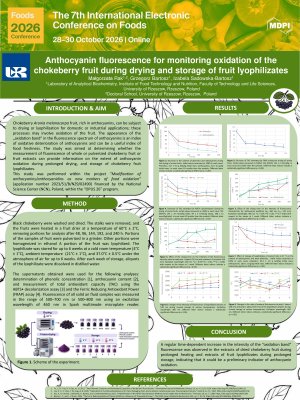
Introduction. Chokeberry Aronia melanocarpa fruit, rich in anthocyanins, can be subject to drying or lyophilization for domestic or industrial applications; these processes may involve oxidation of the fruit. The appearance of the „oxidation band” in the fluorescence spectrum of anthocyanins is an index of oxidative deterioration of anthocyanins and can be a useful index of food freshness. The study was aimed at determining whether the measurement of fluorescence of whole or pulverized chokeberry fruit or fruit extracts can provide information on the extent of anthocyanin oxidation during prolonged drying, and storage of chokeberry fruit lyophilizates.
Methods: The fruits were dried at 60 °C for up to 240 h. The fruit lyophilizates were stored at 4, 22 and 37 °C with air access. Antioxidant activity was assayed by ABTS• decolorization and FRAP assays. The phenolic content with the Folin-Ciocalteu reagent. Fluorescence was measured in a Spark Tecan multiplate reader.
Results and Discussion. Drying of chokeberry fruits was accompanied by a decrease in the anthocyanin content, much higher than the general flavonoid content, and a decrease in the antioxidant capacity of the extracts. A progressive increase in the intensity of the “oxidation band” of anthocyanins, centred at 520-530 nm for the excitation wavelength of 460 nm accompanied the drying process. The intensity of the “oxidation band” also increased during storage of fruit lyophilizates at 22 and 37°C.
Conclusions: The increase in the fluorescence intensity at the “oxidation band” was a regular function of the time of fruit drying and the time of lyophilizate storage and can be a facile index of food and lyophilizate oxidation.
This study was performed within the project “Modification of anthocyanins/anthocyanidins as new markers of food oxidation” (application number 2023/51/B/NZ9/02490) financed by the National Science Center (NCN), Poland, within the “OPUS 26” program.
Keywords
chokeberry
drying
anthocyanins
oxidation
fluorescence
Poster
Anthocyanin fluorescence for monitoring oxidation of the chokeberry fruit during drying and storage of fruit lyophilizates M.Rak.pdf
Natural Deep Eutectic Solvents for Enhanced Extraction of Chicoric Acid from Chicory (Cichorium intybus L.) Herb
Food Processing as a Strategy for Low-FODMAP Functional Ingredient Development: A Systematic Literature Review of Mediterranean Plant Foods