Event submissions
Published
This submission belongs to the session B. Nutritional & Functional Foods of the event The 7th International Electronic Conference on Foods
Published date
23 Oct, 2026
Academic Editor
 Manuel Viuda-Martos
Citation
Agata Wojciechowicz, Dominika Wyboń, Ewa Pejcz, Joanna Harasym, Development of High-Fiber Functional Pasta Enriched with Oat β-Glucan, Apple Pomace, Inulin and Psyllium Husk: Technological and Sensory Evaluation, in Proceedings of The 7th International Electronic Conference on Foods, 28 October–30 October 2026, MDPI: Basel, Switzerland
Share
Email
Facebook
Twitter
LinkedIn
Development of High-Fiber Functional Pasta Enriched with Oat β-Glucan, Apple Pomace, Inulin and Psyllium Husk: Technological and Sensory Evaluation

Agata Wojciechowicz 1
Dominika Wyboń 1
Ewa Pejcz 1

Joanna Harasym 1
1. Department of Biotechnology and Food Analysis, Wroclaw University of Economics and Business, Wrocław, 53-345, Komandorska 118 Street, Poland
Abstract
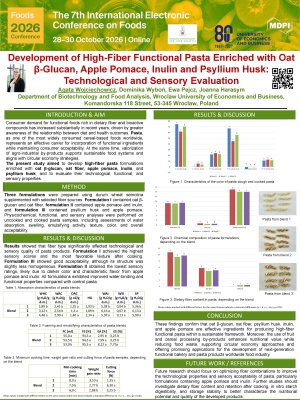
Consumer demand for functional foods rich in dietary fiber and bioactive compounds has increased substantially due to growing awareness of the relationship between diet and health. Pasta, one of the most widely consumed cereal-based foods worldwide, represents an excellent vehicle for incorporating functional ingredients. Simultaneously, the valorization of agro-industrial by-products supports sustainable food production and circular economy strategies. Therefore, this study aimed to develop high-fiber pasta enriched with selected plant-derived fiber sources and to evaluate its technological, functional, and sensory properties.
Three formulations based on durum wheat semolina were prepared: Formulation I contained 5% oat β-glucan and 5% oat fiber, Formulation II contained 10% apple pomace and 3% inulin, and Formulation III contained 5% psyllium husk and 5% apple pomace. Functional properties of the flour blends, including water-holding capacity, water absorption index, water solubility index, swelling power, emulsifying activity and stability, foaming capacity, and oil absorption capacity, were determined. The quality of uncooked and cooked pasta was evaluated by instrumental measurements of color, texture, and cooking performance. Sensory quality was assessed by a trained panel using a 9-point hedonic scale for appearance, texture, flavor, taste, and overall acceptability. Data were analyzed using one-way analysis of variance (ANOVA), and significant differences among means were determined by Duncan's multiple range test (p < 0.05).
Dietary fiber type significantly affected (p < 0.05) the technological and sensory characteristics of pasta. Formulation I achieved the highest sensory scores and the most favorable texture after cooking, whereas Formulation III also showed satisfactory consumer acceptance despite a less homogeneous structure. Formulation II received lower sensory ratings, likely due to the darker color and characteristic flavor of apple pomace. All enriched formulations demonstrated improved water-binding capacity and functional properties compared with conventional pasta. These findings indicate that oat β-glucan, oat fiber, psyllium husk, inulin, and apple pomace are promising ingredients for developing nutritionally enhanced, sustainable pasta products.
Keywords
functional pasta
dietary fiber
oat β-glucan
apple pomace
inulin
psyllium husk
sensory quality
food by-products
sustainable food processing
circular economy
Poster
Development of High-Fiber Functional Pasta.pdf
Food Processing as a Strategy for Low-FODMAP Functional Ingredient Development: A Systematic Literature Review of Mediterranean Plant Foods
A First Approach to combine AI and Predictive Microbiology