Event submissions
Published
This submission belongs to the session S8. Rare Diseases of the event The 1st International Online Conference on Hematology
Published date
23 Oct, 2026
Academic Editor
 Daniela Cilloni
Contribution&Funding
Conceptualization,
[Frederico Larré Pozzebon]
Methodology,
[Frederico Larré Pozzebon]
Investigation,
[Rodrigo Serra Macedo] ; [Giovani Michelin Pacheco]
Data curation,
[Rodrigo Serra Macedo]
Writing - original draft,
[Frederico Larré Pozzebon] ; [Maria Clara Silva De Mello]
Writing - review,
[editing] ; [Frederico Larré Pozzebon] ; [Maria Clara Silva De Mello] ; [Giovani Michelin Pacheco]
Supervision,
[Natália Wirowski]
Funding: --
Citation
Frederico Larré Pozzebon, Maria Clara Silva De Mello, Rodrigo Serra Macedo, Giovani Michelin Pacheco, Natália Wirowski, Efficacy of Crovalimab in Paroxysmal Nocturnal Hemoglobinuria: A Quantitative Synthesis, in Proceedings of The 1st International Online Conference on Hematology, 28 October–30 October 2026, MDPI: Basel, Switzerland
Share
Email
Facebook
Twitter
LinkedIn
Efficacy of Crovalimab in Paroxysmal Nocturnal Hemoglobinuria: A Quantitative Synthesis

Frederico Larré Pozzebon 1
Maria Clara Silva De Mello 2
Rodrigo Serra Macedo 1
Giovani Michelin Pacheco 1
Natália Wirowski 1
1. Medicine, Universidade Católica de Pelotas, Pelotas, Brazil
2. Medicine, Universidade do Vale do Taquari (UNIVATES), Lajeado, Brazil
Abstract
Introduction
Paroxysmal nocturnal hemoglobinuria (PNH) is a rare, life-threatening hematologic disorder characterized by complement-mediated intravascular hemolysis. The disease is associated with substantial morbidity, impaired quality of life, and an increased risk of thrombotic events. Crovalimab, a novel subcutaneous anti-C5 monoclonal antibody, has emerged as a promising therapeutic option by providing sustained terminal complement inhibition. Therefore, this study quantitatively synthesized the available evidence regarding its efficacy in patients with PNH.
Methods
A systematic literature search was conducted in PubMed, Embase, Cochrane Library, and ClinicalTrials.gov in July 2025. The review protocol was prospectively registered in PROSPERO (CRD420250651592) and conducted according to PRISMA 2020 recommendations. Randomized and single-arm clinical trials evaluating crovalimab in adult patients with PNH were eligible. The primary outcomes were transfusion avoidance, hemolysis control, and hemoglobin stabilization. Pooled proportions were calculated using random-effects models with the meta package in R (version 4.4.2).
Results
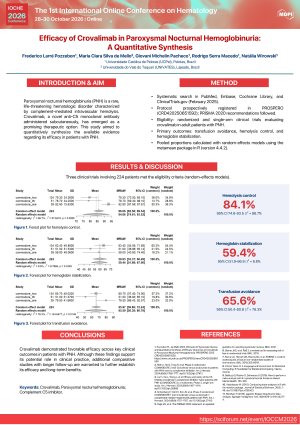
Three clinical trials involving 224 patients met the eligibility criteria. The pooled rate of transfusion avoidance was 65.6% (95% CI, 50.4–80.8; I²=76.3%). Hemolysis control was achieved in 84.1% of patients (95% CI, 74.6–93.5; I²=86.7%), while hemoglobin stabilization occurred in 59.4% (95% CI, 51.9–66.9; I²=8.8%).
Conclusions
Crovalimab demonstrated favorable efficacy across key clinical outcomes in patients with PNH, particularly in achieving hemolysis control and reducing transfusion requirements. Although these findings support its potential role in clinical practice, additional comparative studies with longer follow-up are warranted to better establish its long-term efficacy, safety, and durability of clinical benefits.
Keywords
Crovalimab
Paroxysmal Nocturnal Hemoglobinuria
Complement C5 inhibitor
Poster
poster_crovalimab_PNH.pdf
Readability and Action Cue Visibility in Public Patient Education Pages on Acute Myeloid Leukemia
Positive Predictive Value of [18F]FDG PET/CT for the Detection of Bone Marrow Infiltration in Diffuse Large B-Cell Lymphoma: Impact of Focal versus Diffuse Pattern