Event submissions
Published
This submission belongs to the session D. Food Microbiology & Biotechnologies of the event The 7th International Electronic Conference on Foods
Published date
23 Oct, 2026
Academic Editor
 Efstathios Giaouris
Citation
Mario Terlizzi, Barbara Speranza, Maria Rosaria Corbo, Angela Racioppo, Milena Sinigaglia, Antonio Bevilacqua, A First Approach to combine AI and Predictive Microbiology, in Proceedings of The 7th International Electronic Conference on Foods, 28 October–30 October 2026, MDPI: Basel, Switzerland
Share
Email
Facebook
Twitter
LinkedIn
A First Approach to combine AI and Predictive Microbiology

Mario Terlizzi 1

Barbara Speranza 1
Maria Rosaria Corbo 1
Angela Racioppo 1
Milena Sinigaglia 1

Antonio Bevilacqua 1
1. Department of Agriculture, Food, Natural resources and Engineering (DAFNE), University of Foggia, Foggia, 71122, Italy
Abstract
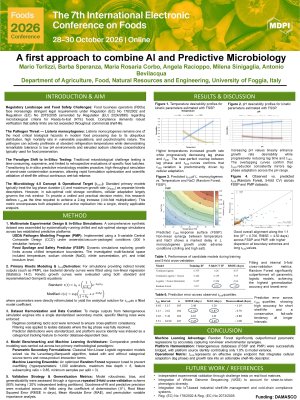
Introduction: This study analyses the application of predictive microbiology as a strategic tool for risk assessment and the optimization of food shelf-life, focusing on a first approach for the development of a unified third-level predictive model capable of estimating the behaviour of Listeria monocytogenes based on multiple environmental and technological variables.
Methods: The methodology initially involved a simulation phase conducted using two reference software programs, FSSP and PMP, based on a multivariate experimental design (DoE). Variables such as temperature, pH, NaCl concentration, nitrite, lactic acid, and initial microbial load were analyzed. The data obtained were then processed using the Gompertz equation to extract kinetic parameters, mainly t100, which represent the time required for a 100-fold increase in the microbial population.
Results: Multivariate statistical analysis, conducted through Pareto chats and response surfaces, highlighted that temperature and pH are the primary determinants of growth rate, while nitrite exerts the most significant inhibitory effect. In the final phase, the integration of data through computational algorithms and the support of generative artificial intelligence allowed for the comparison of various regression models.
Conclusion: The non-linear logistic model was selected as the most effective due to its robustness and biological consistency, proving superior to purely mathematical models like Random Forest in its ability to avoid unrealistic extrapolations. The results confirm that an integrated approach combining predictive software and advanced statistics serves as a fundamental support for designing HACCP self-control systems and for the proactive management of food safety within the Industry 4.0 framework.
Keywords
Food Safety
AI
Predictive Microbiology
Poster
Foods poster - TERLIZZI MARIO.pdf
Development of High-Fiber Functional Pasta Enriched with Oat β-Glucan, Apple Pomace, Inulin and Psyllium Husk: Technological and Sensory Evaluation
Improvement of Paraguayan cane fermentation through nitrogen supplementation: effects on ethanol yield and aromatic profile.