Event submissions
Published
This submission belongs to the session C. Food Physicochemistry & Analysis of the event The 7th International Electronic Conference on Foods
Published date
23 Oct, 2026
Academic Editor
 Joana S. Amaral
Citation
Liz Carolina Ríos, Hugo Arnaldo Caballero, Omayra Beatriz Ferreiro, Improvement of Paraguayan cane fermentation through nitrogen supplementation: effects on ethanol yield and aromatic profile., in Proceedings of The 7th International Electronic Conference on Foods, 28 October–30 October 2026, MDPI: Basel, Switzerland
Share
Email
Facebook
Twitter
LinkedIn
Improvement of Paraguayan cane fermentation through nitrogen supplementation: effects on ethanol yield and aromatic profile.

Liz Carolina Ríos 1

Hugo Arnaldo Caballero 2

Omayra Beatriz Ferreiro 1
1. Departamento de Investigación en Ingenieria y Tecnología de Alimentos, Facultad de Ciencias Químicas, Universidad Nacional de Asunción, San Lorenzo 16601, Paraguay
2. Facultad de Ciencias Químicas, Universidad Nacional de Asunción - UNA, San Lorenzo, 16601, Paraguay
Abstract
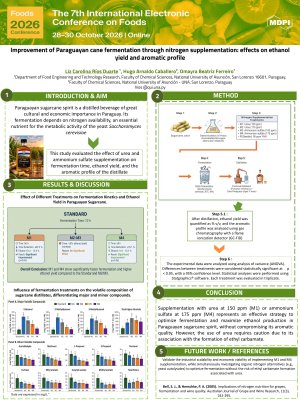
Paraguayan cane spirit is a distilled beverage of high cultural and economic relevance in Paraguay. Its fermentation depends on the availability of nitrogen, an essential nutrient for the metabolic activity of the yeast Saccharomyces cerevisiae. This study evaluated the effect of urea and ammonium sulfate supplementation on fermentation time, ethanol yield, and the aromatic profile of the distillate. Yeast assimilable nitrogen (YAN) of the sugarcane juice was determined using the Sörensen method and adjusted to 150 and 175 ppm. Five treatments were analyzed in triplicate: M1 (urea, 150 ppm YAN), M2 (urea, 175 ppm YAN), M3 (ammonium sulfate, 150 ppm YAN), M4 (ammonium sulfate, 175 ppm YAN), and a control P (56 ppm YAN). Following distillation, ethanol yield was quantified as % v/v, and the aromatic profile was analyzed by gas chromatography with flame ionization detection (GC-FID). Treatments M1 and M4 significantly improved fermentation kinetics (p < 0.05), reducing the fermentation time from 72 h in the control to 56 h (M1) and 59 h (M4), with ethanol yield increases of 12.4% and 15.1%, respectively. In contrast, M2 and M3 showed increases of less than 6%, without statistical significance (p > 0.05). All treatments maintained the concentrations of esters and higher alcohols within the accepted parameters for sugarcane distillates. In conclusion, supplementation with urea at 150 ppm (M1) or ammonium sulfate at 175 ppm (M4) represents an effective strategy to optimize fermentation and maximize ethanol production in Paraguayan cane spirit, without compromising its aromatic quality. However, the use of urea requires caution due to its association with ethyl carbamate formation.
Keywords
distilled beverage
Paraguayan cane
fermentation
nitrogen salts.
Poster
Sciforum-198258 LIZ RIOS.pdf
A First Approach to combine AI and Predictive Microbiology
Upcycling Agaricus bisporus Stems: Ultrasound-Assisted and NADES for Protein Extraction