Event submissions
Published
This submission belongs to the session C. Food Physicochemistry & Analysis of the event The 7th International Electronic Conference on Foods
Published date
23 Oct, 2026
Academic Editor
 Joana S. Amaral
Citation
Vanessa Grifoll Garcia, Patricia Bermúdez Gómez, Margarita Pérez-Clavijo, Upcycling Agaricus bisporus Stems: Ultrasound-Assisted and NADES for Protein Extraction, in Proceedings of The 7th International Electronic Conference on Foods, 28 October–30 October 2026, MDPI: Basel, Switzerland
Share
Email
Facebook
Twitter
LinkedIn
Upcycling Agaricus bisporus Stems: Ultrasound-Assisted and NADES for Protein Extraction

Vanessa Grifoll Garcia 1

Patricia Bermúdez Gómez 1
Margarita Pérez-Clavijo 1
1. Centro Tecnológico de Investigación del Champiñón de La Rioja (CTICH), Autol, Spain
Abstract
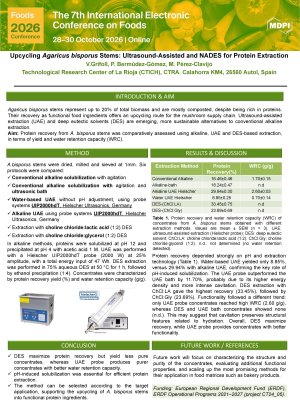
The global production of Agaricus bisporus generates substantial quantities of stems, representing up to 20% of total biomass and typically managed through low-value applications such as composting or incineration. However, these by-products are rich in valuable biomolecules, particularly proteins. This study evaluates innovative and sustainable extraction technologies to recover proteins from mushroom stems for incorporation as functional food ingredients.
Seven extraction protocols were comparatively assessed: conventional alkaline solubilization (pH 12) with agitation, ultrasound-assisted extraction (UAE) using bath and probe systems, water-based UAE without pH adjustment, and green solvent extraction using two deep eutectic solvents (DES): choline chloride:lactic acid (1:2) and choline chloride:glycerol (1:2). For alkaline methods, proteins were solubilized at pH 12 and precipitated at pH 4 (isoelectric point) using acetic acid (1M). For the NADES approach, extraction was performed at 50 °C for 1 h in a 75% DES aqueous solution, followed by ethanol precipitation (1:4). All concentrates were characterized for protein recovery yield (%) and water retention capacity (WRC).
Results demonstrated that DES extraction with choline chloride:lactic acid achieved the highest protein recovery (33.45%), followed by alkaline extraction combined with UAE probe (29.94%), which outperformed UAE bath treatment by 11.70%. Choline chloride:glycerol DES also showed competitive performance (23.69%). Water-based UAE without pH adjustment yielded significantly lower recovery (8.85%), highlighting the critical role of pH-induced solubilization. Notably, UAE-derived concentrates exhibited superior WRC (2.60 g/g) compared to choline chloride:lactic acid NADES extracts (0 g/g), suggesting that ultrasound-induced cavitation preserves protein structural features associated with hydration capacity, a key attribute for food texture applications.
This work identifies NADES and UAE as the most effective strategies for recovering functional protein concentrates from A. bisporus stem by-products: NADES maximizes extraction yield, while UAE produces concentrates with superior water retention capacity, broadening applicability across food formulation needs and providing a viable upcycling pathway for the mushroom supply chain.
Funding: European Regional Development Fund (ERDF), ERDF Operational Programs 2021–2027 (project CT24_05).
Keywords
Agaricus bisporus
Mushroom Stems
Deep Eutectic Solvents
Ultrasound-assisted extraction
Protein recovery.
Poster
Foods poster_VGRIFOLL.pdf
Improvement of Paraguayan cane fermentation through nitrogen supplementation: effects on ethanol yield and aromatic profile.
FTIR INSIGHTS INTO WHEAT FLOUR GLUTEN: LINKING SECONDARY STRUCTURE OF GLIADINS AND GLUTENINS WITH BAKING-RELATED FUNCTIONALITY