Event submissions
Published
This submission belongs to the session C. Food Physicochemistry & Analysis of the event The 7th International Electronic Conference on Foods
Published date
23 Oct, 2026
Academic Editor
 Joana S. Amaral
Citation
Andrei-Cristian Stănicel, Ana-Mihaela Mazilu, Nicole Alina Turbatu, Alina Moroşan, Nicoleta-Aurelia Chira, FTIR INSIGHTS INTO WHEAT FLOUR GLUTEN: LINKING SECONDARY STRUCTURE OF GLIADINS AND GLUTENINS WITH BAKING-RELATED FUNCTIONALITY, in Proceedings of The 7th International Electronic Conference on Foods, 28 October–30 October 2026, MDPI: Basel, Switzerland
Share
Email
Facebook
Twitter
LinkedIn
FTIR INSIGHTS INTO WHEAT FLOUR GLUTEN: LINKING SECONDARY STRUCTURE OF GLIADINS AND GLUTENINS WITH BAKING-RELATED FUNCTIONALITY

Andrei-Cristian Stănicel 1
Ana-Mihaela Mazilu 1
Nicole Alina Turbatu 1
Alina Moroşan 1
Nicoleta-Aurelia Chira 1
1. "C. Nenitescu" Department of Organic Chemistry, Faculty of Chemical Engineering and Biotechnologies, National University of Science and Technology POLITEHNICA Bucharest, Bucharest, Romania
Abstract
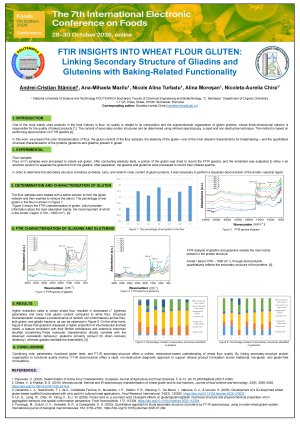
Background: Wheat flour quality is largely determined by the composition and supramolecular organization of gluten proteins, whose three-dimensional network controls dough viscoelasticity and gas retention in baked products. While functional parameters such as gluten content, elasticity, and extensibility are routinely measured, their molecular underpinnings in terms of protein secondary structure are less frequently addressed using rapid, non-destructive spectroscopic tools.
Objective: This study aimed to develop a rapid, non-destructive FTIR spectroscopy approach that links the secondary-structure features of wheat flour gluten proteins (gliadins and glutenins) to their compositional traits and key functional properties relevant for dough viscoelasticity and baking performance.
Methods: Commercial white and whole wheat flours were characterized in terms of colour (CIE Lab* coordinates), gluten content, and gluten functional properties. All samples (flour, bulk gluten, gliadins, and glutenins) were analysed by FTIR spectroscopy in the amide I region, followed by Gaussian deconvolution to quantify secondary-structure motifs (α-helices, β-sheets, turns, and random coils).
Results: Whole wheat flour exhibited a lower gluten content than white flour and a decreased L* value, indicating a darker appearance consistent with higher extraction rate. Random coil structures predominated in flour, bulk gluten, and gliadin fractions, whereas glutenins showed a higher proportion of intermolecular β-sheet motifs, in line with their fibrillar character and extensive disulfide crosslinking. These structural features were consistent with the observed viscoelastic behaviour, with glutenins primarily supporting elasticity and gliadins contributing to dough extensibility.
Conclusions: The combined evaluation of colour parameters, functional gluten tests, and FT-IR-based secondary-structure profiling provides a coherent, mechanism-oriented picture of wheat flour quality. The proposed FT-IR deconvolution approach emerges as a rapid, non-destructive tool for relating molecular-level protein organization to technological performance and may support the rational formulation of wheat-based products and gluten-reduced or gluten-free alternatives.
Keywords
wheat flour
gluten
gliadins
glutenins
FTIR spectroscopy
secondary structure
viscoelastic properties
Poster
Poster WHEAT FLOUR GLUTEN_Sciforum-176628.pdf
Upcycling Agaricus bisporus Stems: Ultrasound-Assisted and NADES for Protein Extraction
Decoding the Volatile Fingerprint of Fermented Underutilized Fruits and Citrus: A Multivariate Approach to Functional Beverage Design