Event submissions
Published
This submission belongs to the session S4. Non-Hodgkin Lymphoma of the event The 1st International Online Conference on Hematology
Published date
23 Oct, 2026
Academic Editor
 Gerardo Musuraca
Citation
Abdel Amide Gbadamassi, Zakaria Ouassafrar, Sophia Berrada, Hafsa Bensimimou, Halima Batani, Mahdi Ahmed, Nizar Dahmaoui, Cosme Boutros Nato, Meryem Qachouh, Amal Guensi, Positive Predictive Value of [¹⁸F]FDG PET/CT for the Detection of Bone Marrow Infiltration in Diffuse Large B-Cell Lymphoma: Impact of Focal versus Diffuse Pattern, in Proceedings of The 1st International Online Conference on Hematology, 28 October–30 October 2026, MDPI: Basel, Switzerland
Share
Email
Facebook
Twitter
LinkedIn
Positive Predictive Value of [18F]FDG PET/CT for the Detection of Bone Marrow Infiltration in Diffuse Large B-Cell Lymphoma: Impact of Focal versus Diffuse Pattern

Abdel Amide Gbadamassi 1,2
Zakaria Ouassafrar 1
Sophia Berrada 3
Hafsa Bensimimou 1
Halima Batani 1
Mahdi Ahmed 1
Nizar Dahmaoui 3
Cosme Boutros Nato 4
Meryem Qachouh 3
Amal Guensi 1
1. Nuclear Medicine Department, Ibn Rochd University Hospital Center, Casablanca, Morocco
2. Laboratory of Mechanics and High Energy Physics, Faculty of Sciences Ain Chok, Hassan Second University of Casablanca, Casablanca, Morocco
3. Hematology and Pediatric Oncology Department of August 20 Hospital, Ibn Rochd University Hospital Center, Casablanca, Morocco
4. Mohammed VI Center for Cancer Treatment, Ibn Rochd University Hospital Center, Casablanca, Morocco
Abstract
Introduction:
Diffuse large B-cell lymphoma (DLBCL) is the most common and aggressive subtype of non-Hodgkin lymphoma, accounting for about 30% of cases. Bone marrow involvement is a key prognostic factor and corresponds to stage IV in the Ann Arbor classification. [18F]FDG PET/CT has shown good diagnostic performance for detecting bone marrow involvement compared with bone marrow biopsy (BMB). However, the significance of different bone marrow uptake patterns (focal versus diffuse) in predicting true histological infiltration remains unclear. This study aimed to assess the impact of these patterns on histological confirmation in DLBCL.
Patients and Methods:
This retrospective single-center study included newly diagnosed adult patients with DLBCL who showed bone marrow involvement on [18F]FDG PET/CT and underwent BMB. The positive predictive value (PPV) of PET/CT was calculated, and focal and diffuse uptake patterns were compared.
Results:
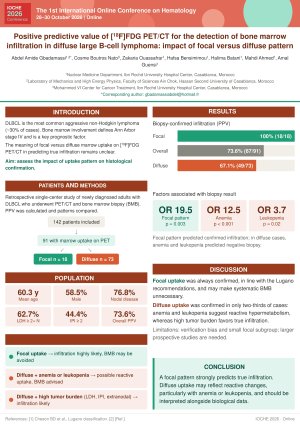
A total of 142 patients were included (58.5% male; mean age 60.3 years), with predominantly nodal disease (76.8%). Elevated LDH (≥2× normal) was found in 62.7%, and 44.4% had an IPI ≥2. Bone marrow uptake on PET/CT was observed in 91 patients. Histological confirmation was obtained in 67 cases, yielding an overall PPV of 73.6%. Among PET-positive patients, 18 had a focal pattern and 73 a diffuse pattern. Bone marrow infiltration was confirmed in 100% of focal cases (18/18) versus 49/73 diffuse cases. The focal pattern was strongly associated with confirmed infiltration (OR = 19.5; p = 0.003). In patients with a diffuse pattern, anemia (OR = 12.5; p < 0.001) and leukopenia (OR = 3.7; p = 0.02) were associated with negative biopsy results.
Conclusion:
[18F]FDG PET/CT shows high diagnostic value for bone marrow involvement in DLBCL. A focal uptake pattern strongly predicts true infiltration, whereas diffuse uptake may reflect reactive changes, particularly in patients with anemia or leukopenia.
Keywords
Bone Marrow
Diffuse Large B-Cell Lymphoma
Positron-Emission Tomography Computed Tomography
Poster
Poster_IOCHE_2026_A0_pdf.pdf
Efficacy of Crovalimab in Paroxysmal Nocturnal Hemoglobinuria: A Quantitative Synthesis
Hypoxia-Induced Extracellular Vesicles Regulate BCR::ABL1 Expression in Chronic Myeloid Leukemia