Event submissions
Published
This submission belongs to the session D. Food Microbiology & Biotechnologies of the event The 7th International Electronic Conference on Foods
Published date
23 Oct, 2026
Academic Editor
 Efstathios Giaouris
Citation
Anagha Murali, Divyashri G, Production and Evaluation of a Novel GABA-Producing Plant Yogurt and its Functional Benefits, in Proceedings of The 7th International Electronic Conference on Foods, 28 October–30 October 2026, MDPI: Basel, Switzerland
Share
Email
Facebook
Twitter
LinkedIn
Production and Evaluation of a Novel GABA-Producing Plant Yogurt and its Functional Benefits

Anagha Murali 1
Divyashri G 2
1. Department of Biotechnology, Ramaiah Institute of technology, Bangalore, Karnataka, India
2. Bioproducts Research, IomBiom PVT Limited, Bangalore, India
Abstract
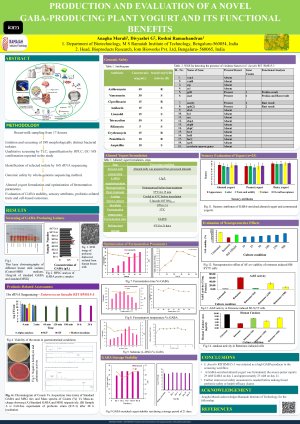
Depression and anxiety are prevalent mental health disorders, and growing evidence implicates the gut–brain axis in the regulation of neurophysiological processes. Psychobiotics, defined as probiotics with potential effects on the gut–brain axis, have consequently gained attention as candidate functional food components. However, the application of human breast milk-derived psychobiotic strains in the development of GABA-enriched fermented foods remains largely unexplored. Gamma-aminobutyric acid (GABA), the principal inhibitory neurotransmitter in the mammalian central nervous system, is a bioactive metabolite produced by certain microorganisms during fermentation. In this study, the previously characterized GABA-producing strain Enterococcus faecalis RIT BMS15-3, isolated from human breast milk, was employed as a starter culture for the development of GABA-enriched almond yogurt. Fermentation conditions were systematically optimized by evaluating L-monosodium glutamate (L-MSG) concentration, fermentation temperature, and fermentation time to maximize microbial GABA production. The optimized formulation was subsequently characterized for GABA stability, antioxidant activity, water-holding capacity, viscosity, and sensory properties. Fermentation with E. faecalis RIT BMS15-3 enhanced GABA production in the almond-based matrix, and the optimized yogurt retained detectable GABA levels and viable bacterial counts during storage. The fermented product also demonstrated measurable antioxidant activity and acceptable sensory characteristics. Overall, the findings demonstrate the feasibility of utilizing a human breast milk-derived GABA-producing bacterial strain for the development of a plant-based fermented food with enhanced bioactive value. Further in vivo and clinical investigations are warranted to determine whether consumption of the GABA-enriched product translates into measurable neurophysiological or mental health benefits.
Keywords
GABA
Psychobiotics
functional food
Enterococcus faecalis RIT BMS15-3
Optimization
Plant yogurt
Poster
Foods2026_Poster_GABA_Almond_Yogurt Final 13102026.pdf
Decoding the Volatile Fingerprint of Fermented Underutilized Fruits and Citrus: A Multivariate Approach to Functional Beverage Design
Heat-stable antifungal activity of a wild Bacillus sp. against food-spoilage moulds: a promising approach for clean-label food preservation